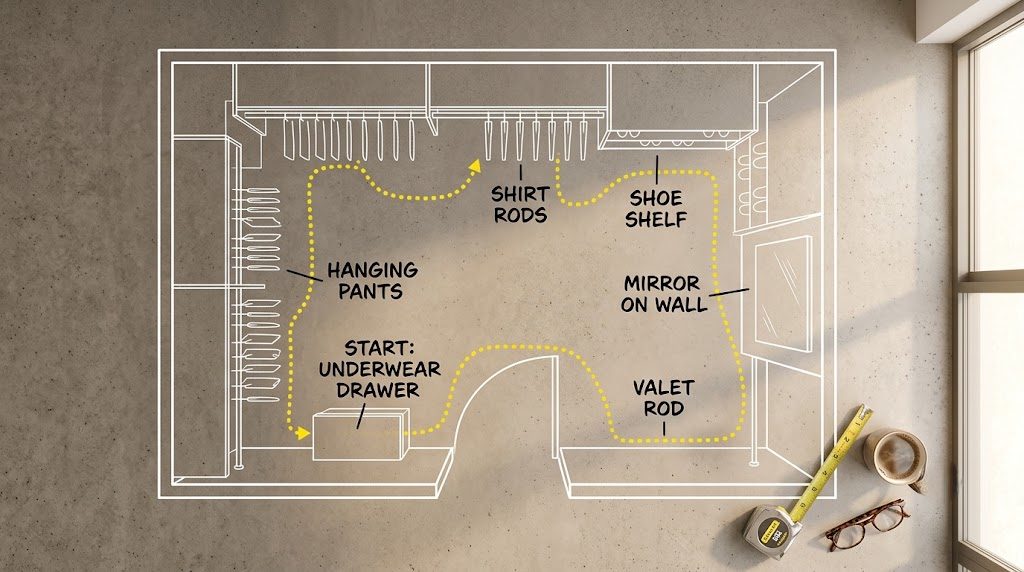
Kitchen designers have used the work triangle for decades: position the sink, stove, and refrigerator in a triangle so the cook moves efficiently between the three most-used stations. A closet has its own version of this triangle, and almost nobody designs for it. I call it the getting-ready circuit, and once you see it mapped out, you'll never unsee it.
Most closets are organized by category — all shirts together, all pants together, all shoes in one zone. That makes sense for inventory. It makes no sense for getting dressed. You don't walk to the shirt section, put on a shirt, walk back to the underwear drawer, put on underwear, then walk to the shoe rack. You put clothes on your body in a sequence. Your closet should match that sequence.
Mapping Your Personal Circuit
The getting-ready circuit is the path your body takes from the first item you put on in the morning to the last item you grab before you walk out the door. It's personal, it's consistent, and it's measurable.
Start With Your Sequence
Stand in your current closet — or the empty room that will become your closet — and physically walk through your morning. For most people, the sequence goes like this: underwear, socks, pants or skirt, shirt or blouse, shoes, accessories, final mirror check, out the door. Some people do shoes before shirt. Some people do accessories before shoes. The order doesn't matter as long as it's yours.
Now look at your closet layout. If your underwear drawer is on the far left wall and your pants are hanging on the far right wall, you're walking across the room in your underwear every morning. If your mirror is behind the door and your accessories are in a drawer under the window, you're making three separate trips to three separate corners. That's not a routine. That's a commute.
The Ideal Circuit Layout
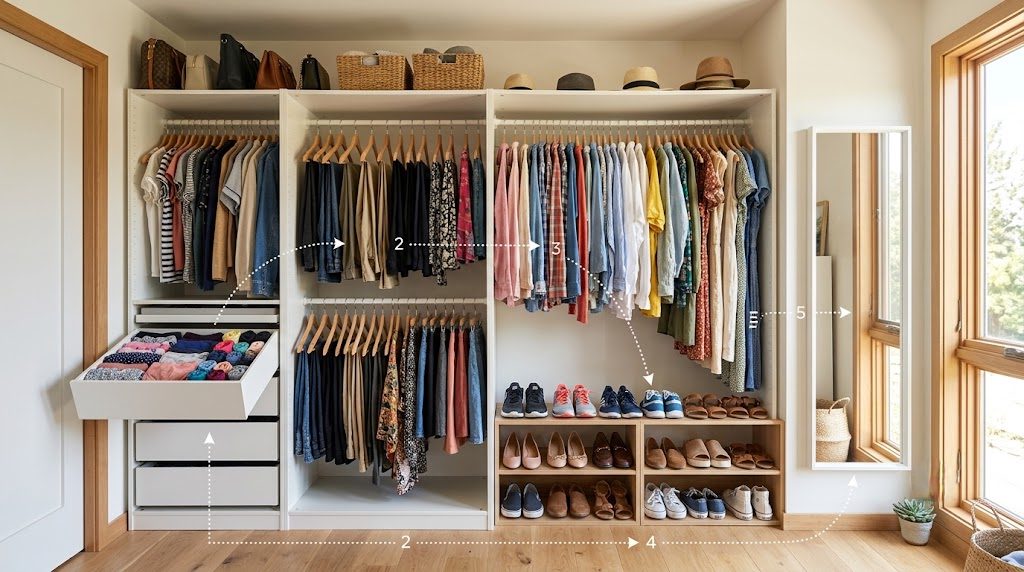
Here's the sequence I design for most clients, adapted to their specific flow. Starting from the closet entrance, the underwear drawer is first — waist-high, in a drawer stack immediately to the right or left of the door. Next, the hanging pants and skirts are on a rod directly above or adjacent to that drawer stack. This puts everything you put on your lower body in one 3-foot zone.
Next in the circuit comes the shirt and blouse rod, ideally on the same wall run as the pants but slightly further into the room. After the shirt rod, the shoe storage lives at floor level directly below or immediately adjacent. This is critical: your shoes should be the last thing you grab before you step toward the mirror, because you put them on last.
The Mirror as Destination
The mirror is the final stop on the circuit. Position it so you arrive at it naturally after you've put on your shoes. If possible, mount the mirror on a wall that receives natural light, or flank it with vertical sconces at face height. The mirror is not an afterthought hung on the back of a door. It's the terminal of your getting-ready circuit, the place where you confirm that everything you just put on your body looks the way you intended. Give it the wall space and lighting it deserves.
The Accessories Station
Accessories — jewelry, watches, belts, scarves — need a dedicated station within the circuit. For most people, this station belongs between the shirt rod and the mirror, because accessories are the last thing you add before the final check. A shallow drawer with felt-lined dividers, mounted at about 40 inches from the floor, is ideal. If drawer space is limited, a valet rod with a small shelf above it can hold a jewelry tray and a watch box. The key is that you don't have to leave the circuit to access it.
Why This Changes Everything
When your closet follows your getting-ready sequence, your morning shrinks. Not by minutes — by friction. You stop retracing steps. You stop standing in the middle of the room trying to remember where you put your belt. You stop walking past the mirror twice before you're actually ready to use it. The circuit turns getting dressed into a single, fluid motion from door to mirror.
This principle works in a reach-in closet, a walk-in closet, or a 12-by-12 dressing room. The footprint changes. The sequence doesn't. Map yours before you build a single shelf, and your closet will work with your body instead of against it.



No comments yet — be the first to share a thought.