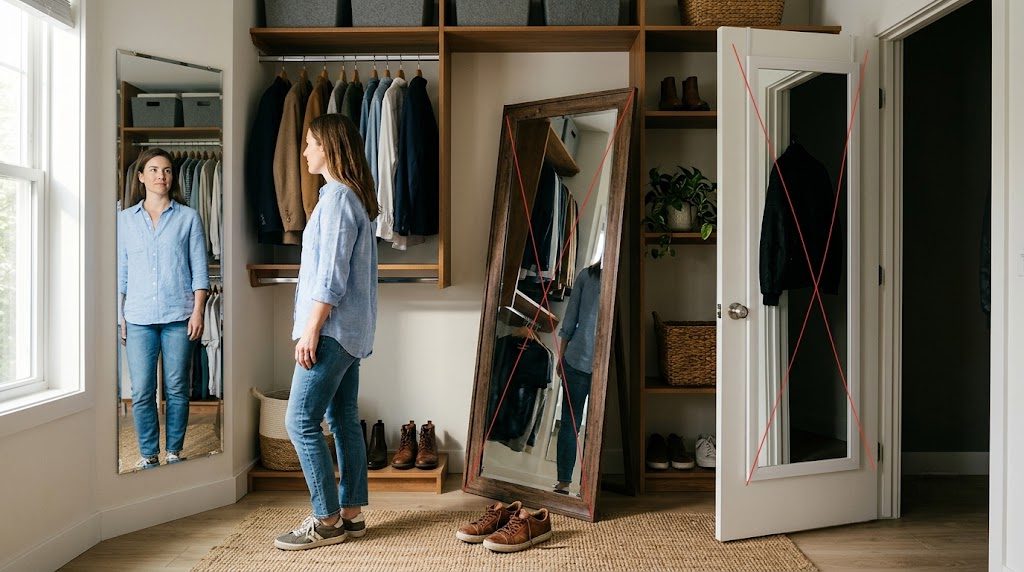
The mirror is the last thing most people think about when planning a closet, and it's the first thing they use when they're done getting dressed. That mismatch — last in planning, first in use — is why so many closets have a mirror leaned against the wall, propped on a dresser, or screwed to the back of a door where it reflects nothing useful.
A mirror is not an accessory. It's the final check. It's the piece of equipment that tells you whether everything you just put on your body actually works together. And it deserves the same structural planning as your hanging rods and your lighting circuits.
Placement: Where the Light Is, Not Where the Wall Is
The most common mirror placement mistake is treating it as wall decor — finding an empty patch of drywall and hanging it there. That's backwards. The mirror doesn't go where the wall space is. It goes where the light is.
Natural Light Is the Priority
If your closet has a window or skylight, the mirror should face it. Not adjacent to it. Facing it. You want daylight hitting your body and bouncing into the mirror, not hitting the mirror and bouncing past you. If the window is on the north wall, the mirror goes on the south wall. If the window is on the east wall, the mirror goes on the west wall. This gives you the most accurate color rendering you can get without a professional lighting setup.
If you have no natural light at all — common in interior closets — the mirror must have dedicated lighting on either side, not above. Overhead light casts shadows down your face and body, creating dark circles under your eyes and obscuring the fit of layered clothing. Side lighting at face height eliminates those shadows and gives you an honest reflection. More on this in the lighting section.
Distance: How Far Back Can You Stand?
A mirror needs viewing distance. You need to stand at least 4 to 5 feet back from a full-length mirror to see your entire body in a single glance. If your closet aisle is only 30 inches wide, you cannot back up far enough to see yourself head to toe in a wall-mounted mirror without pressing your back against the opposite wall. In narrow closets, the mirror must go on the end wall — the wall you walk toward — so the aisle itself becomes your viewing distance. You walk in, you see yourself at the far end, you have the full depth of the closet to step back.
If your closet is a reach-in, mount the mirror on the wall opposite the closet, not on the closet doors. You open the doors, you turn around, you see yourself with the full depth of the room behind you. Door-mounted mirrors only work if you can close the door and stand far enough back. Most bedrooms don't offer that distance because the bed is in the way. Check your clear floor before you mount.
Size: Full-Length Means Full-Length
A full-length mirror is not negotiable. A mirror that cuts you off at the knees or the chest tells you nothing about whether your shoes work with your trousers or your necklace works with your neckline. Minimum height for a full-length mirror is 48 inches. That shows a person up to about 5 foot 8 from head to toe if the mirror is mounted at the correct height and the viewing distance is adequate. For anyone taller, or for a more generous reflection, a 60 to 68-inch mirror is better. Width should be at least 16 inches to show your full body width with some shoulder room.
One Mirror or Two?
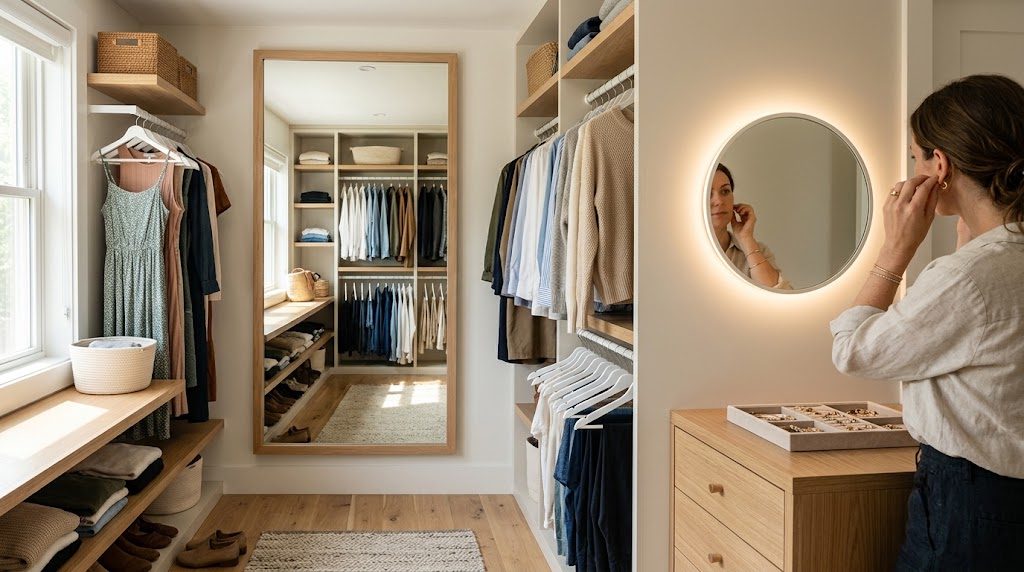
A single full-length mirror serves the primary check. A second, smaller mirror — an 18-inch round or oval at face height, mounted near the accessories station — serves the detail check: earrings, collar alignment, makeup, hair. The two-mirror setup separates the full-body check from the face check and prevents you from having to walk back to the main mirror to examine your earrings. This is a luxury only if space allows, but it's an inexpensive one.
Lighting: Side Light, Not Top Light
I've said this before in the lighting post, but it bears repeating in the context of mirrors. A mirror is only as good as the light that hits it. One ceiling fixture above the mirror casts shadows downward, creating unflattering dark troughs under your eyes and chin. The fix is vertical lighting on both sides of the mirror, mounted at roughly 60 to 66 inches from the floor — face height for most adults. If hardwired sconces aren't possible, battery-operated LED strip lighting in a 3000K color temperature, mounted vertically on either side of the mirror, achieves the same effect for under $100.
Backlit Mirrors: Beautiful, Incomplete
A backlit mirror — one with an LED halo behind the glass — is beautiful and provides excellent ambient light. But it doesn't illuminate your face. It illuminates the wall behind the mirror. If you choose a backlit mirror, supplement it with side lighting or a dedicated face-height fixture. The halo alone will leave your reflection in shadow.
Why Leaning Isn't a Plan
A mirror leaned against the wall is tilted at an angle. That angle distorts your proportions — it makes you look shorter or taller depending on where you stand relative to it. It's also unstable. I've seen leaning mirrors slide on hardwood floors, get knocked over by a vacuum cleaner, and crack in the corner where the weight of the glass met the floor. A leaning mirror is temporary by nature, and temporary things in a permanent room eventually fail.
Mount your mirror. Anchor it to the wall. Position it where the light is. Give it the viewing distance it needs. That's the difference between a mirror you glance at and a mirror you trust.
No comments yet — be the first to share a thought.