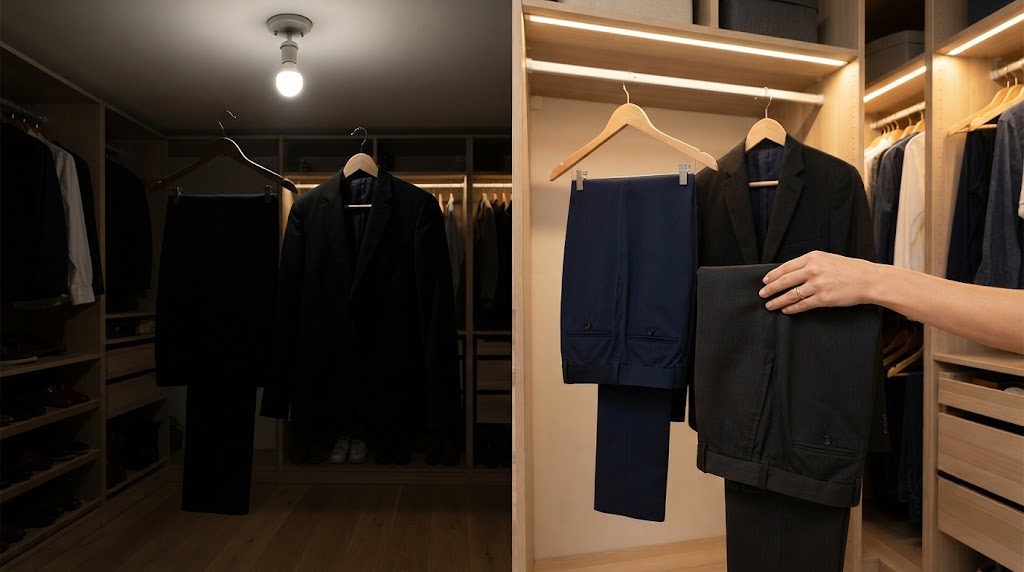
I once had a client call me, genuinely frustrated, and ask, "Kate, did I buy navy pants or black ones?" She was standing in her brand-new custom closet, lit by a single recessed light in the center of the ceiling, and she could not tell.
This woman had spent thousands on cabinetry, hardware, and a stunning quartzite island top. But the $12 builder-grade ceiling fixture had rendered her entire wardrobe ambiguous. Every dark garment looked the same. Shadows pooled inside her shoe cubbies. The back of every shelf was a cave.
Lighting is not the finishing touch on a closet. It is the first thing your eyes use to do their job. Get it wrong, and everything else you spent money on becomes harder to appreciate.
Overhead Fixtures: Necessary, Not Sufficient
A single ceiling dome or recessed light in the center of a walk-in closet is the most common lighting plan in American homes, and it is almost always wrong.
Here's why: when you stand in front of your hanging clothes, your body is between the light source and the garments. You cast a shadow directly onto the thing you're trying to see. Rod-hung clothes face the room, but the light is above and slightly behind you. That geometry guarantees poor visibility, especially for items at knee height or below.
The Minimum Overhead Fix
If overhead lighting is your only option — say, in a reach-in closet with no electrical budget for more — use at least two fixtures, positioned so you never stand directly between both lights and your clothes. In a walk-in, run a row of slim LED recessed lights along the center of the aisle, spaced roughly every 4 feet. Aim for 3000K color temperature. Warmer light (2700K) makes navy and black blend together. Cooler light (4000K and above) turns skin tones unflattering and makes the closet feel like a hospital supply room. 3000K is the sweet spot: warm enough to feel human, neutral enough to show true color.
Task Lighting: Where the Real Work Happens
Task lighting puts illumination exactly where your eyes need it — inside shelves, under hanging rods, and at drawer level. This isn't decorative. It's functional.
Integrated Shelf Lighting
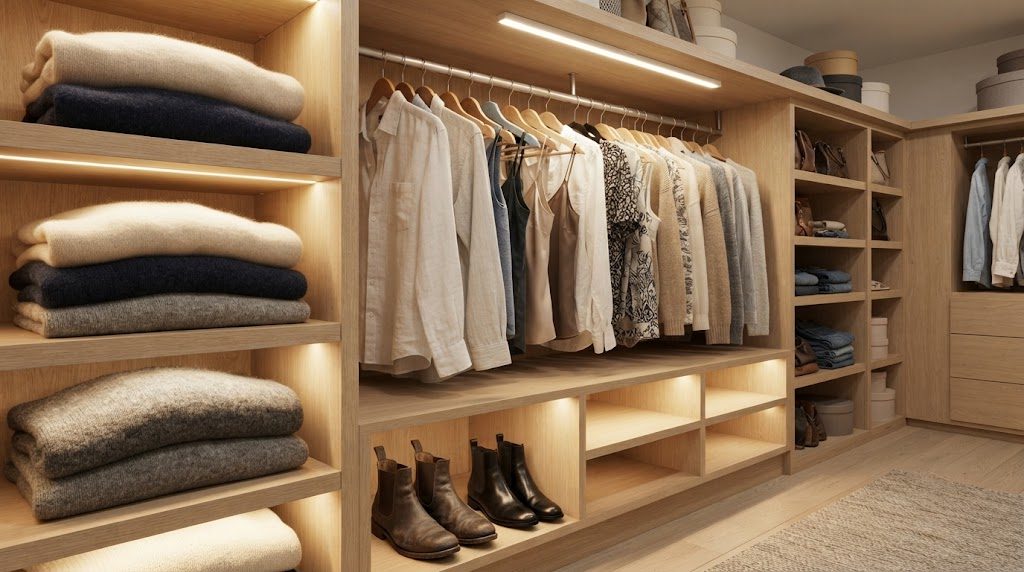
LED strip lights mounted to the underside of shelves eliminate shadows and illuminate folded items from above. Run them along the front edge of each shelf, or recess them into a channel for a cleaner look. The goal is to light the item below, not blind the person standing in front of it. Use a diffused lens so you don't see individual LED dots reflected in glossy surfaces.
Rod Lighting
Hanging garments benefit from a vertical wash of light. A linear LED fixture mounted on the ceiling directly above and slightly in front of the hanging rod will illuminate the faces of shirts and jackets, not their shoulders. Paired with integrated shelf lighting above, this combination lets you see the color of a blouse at both eye level and waist level.
Mirror Lighting: The Final Check
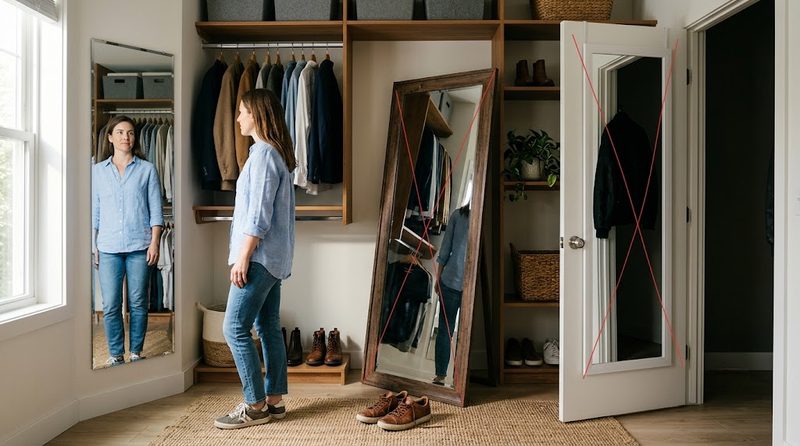
A full-length mirror is useless if the light doesn't hit your body evenly. A single overhead light will cast shadows under your chin, your eyes, and any layered outfit. Place vertical sconces or LED strips on either side of the mirror, at face height. If that's not possible, mount the mirror on a wall that faces your natural light source, and supplement with a fixture directly above the mirror that washes downward. This is the difference between checking your outfit and guessing at it.
A closet is a small room with a big job. Light it like one. Layer your sources. Aim for 3000K. And never, ever trust a single bulb in the middle of the ceiling to tell you whether your pants are navy or black.
No comments yet — be the first to share a thought.