Walk through a closet showroom and everything looks good under those warm, integrated LEDs. The shelves are sleek, the finishes are uniform, and the salesperson uses words like "premium" and "European" with confidence. But three years later, in your actual closet, a shelf sags under a stack of denim, an edge band peels away from a drawer front, and the beautiful wood grain you paid extra for turns out to be a photograph glued to particleboard.
The material your closet is made from determines its lifespan, weight capacity, moisture resistance, and repairability. Understand what you're actually buying before you pay for it.
Melamine: The Workhorse With a Weak Spot
Melamine is the most common closet material in North America, and it's not inherently bad. But it has one fatal flaw, and knowing it will save you from a shelf collapse.
What It Actually Is
Thermally fused melamine is a resin-saturated decorative paper bonded under heat and pressure to a particleboard or MDF core. It's not wood. It's not plastic. It's a composite, and its quality depends almost entirely on two things: the density of the core and the quality of the edge band.
The Edge Band Tells the Truth
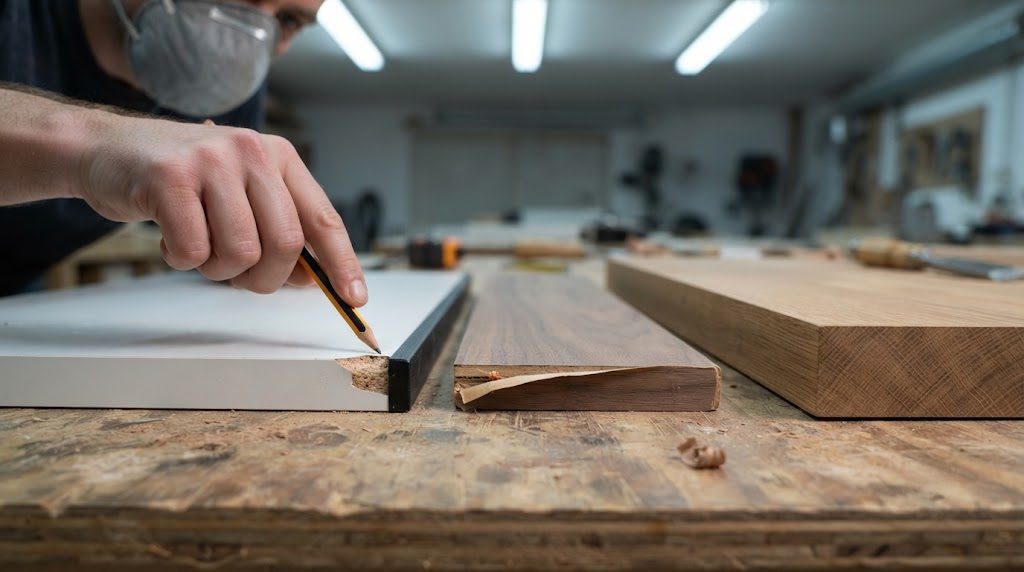
The decorative surface of melamine is waterproof and fairly scratch-resistant. The core is not. If the edge band — the thin strip of PVC, ABS, or wood veneer applied to the cut edges — fails, moisture enters the particleboard core, and the panel swells like a sponge. I've seen melamine shelves in Oklahoma closets balloon at the edges after one humid summer, all because the edge band was a paper-thin strip of pre-glued veneer instead of a proper 1mm to 2mm thick PVC band applied with hot-melt adhesive.
How to spot cheap melamine in a showroom: run your fingernail along the edge band. If it feels like tape, it's the thin stuff. Look at the corner joints. If the edge band is already lifting, walk away. Also, ask about the core density. A high-density particleboard core holds screws better and resists sagging. Low-density cores fail under heavy folded denim within two years.
Melamine is a smart choice when budget is primary and you can confirm the edge band is thick and well-applied. It's also perfect for upper shelves that hold lightweight items. But for shelves spanning more than 30 inches carrying heavy loads, look elsewhere.
Wood Veneer: The Compromise That Can Disappoint
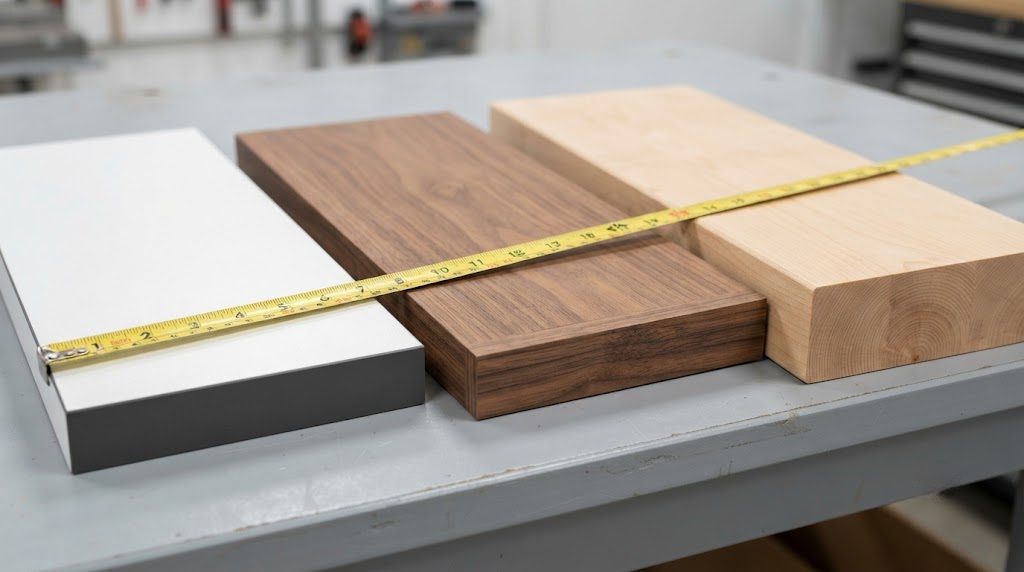
Wood veneer is a thin slice of real wood — typically less than 1/16 inch — glued onto a substrate of plywood, MDF, or particleboard. It gives you the look of solid wood at a fraction of the cost. But it's a surface, not a structure.
What Matters Beneath the Veneer
The performance of a veneer shelf depends almost entirely on the substrate. Veneer over Baltic birch plywood is strong, stable, and holds screws well. Veneer over MDF is heavier and more prone to sag. Veneer over particleboard is the cheapest option and offers little structural advantage over plain melamine — you're paying for the look, not the performance.
Veneer also has edge-band vulnerability. A high-quality shop will use solid wood edge banding on a veneer panel, sanded and finished to match. A budget manufacturer will use a pre-glued veneer strip that lifts over time. Ask what's under the veneer and how the edges are finished. If the salesperson can't answer, assume it's MDF with a thin edge strip.
Solid Wood: The Lifetime Choice, Not Always the Right One
Solid wood shelves — typically maple, oak, or poplar in painted applications — are the strongest, most repairable option. They can be sanded and refinished. They won't delaminate. They hold screws indefinitely. But they cost significantly more, and wood moves.
Movement, Cost, and Weight
Solid wood expands and contracts with humidity. In an unconditioned or poorly ventilated closet, wide solid wood panels can cup or warp over time. For shelves wider than 12 inches, I recommend plywood with a solid wood face frame rather than a full solid panel, unless the closet is climate-controlled year-round.
Cost varies wildly. Paint-grade poplar is affordable and takes paint beautifully. Maple and oak are mid-range hardwoods that wear well. Walnut and cherry are premium. If you're investing in solid wood, put it where it shows and where it matters most: drawer fronts, island countertops, and floating shelves at eye level.
The best closets I've designed use a mix. Melamine for upper shelves and hidden storage. Wood veneer or solid wood for drawer faces and visible surfaces. Solid plywood or high-density particleboard for structural panels. The material should match the job, not the showroom pitc



No comments yet — be the first to share a thought.