The best walk in closet lighting ideas begin before drywall, not after the shelves are installed. A closet is a small working room, and its lighting has to do more than look attractive in a photograph. You need to see navy next to black at 6:15 AM, judge whether a white shirt is clean, and find the pair of shoes pushed behind the hamper. That requires planning circuits, fixture locations, color temperature, and clearances before you spend money on accessories.
Start with the electrical plan
Draw the closet layout first. Mark the door swing, hanging sections, drawers, shelves, mirror, hamper, and any center island. Then mark where your body will stand while using each zone. Those positions matter more than the center of an empty ceiling.
A basic walk-in closet often needs one ceiling light, but a larger room usually works better with two or three lighting zones. Plan one circuit for general illumination and a second for task or display lighting. A dimmer on the main circuit is useful, but do not put every fixture on one switch if the room has a long aisle. You will not want six bright lights on when you only need socks from one drawer.
Have the electrician locate junction boxes and switches before the closet company arrives. Keep the switch near the entry latch side, generally around 42 to 48 inches above the finished floor. If the closet connects to a bathroom, consider a three-way switch so the light can be controlled from both sides.

Use layers instead of one bright fixture
Many walk-in closets fail because one flush-mount fixture is expected to light every shelf. Your head and shoulders then block the light exactly where you are trying to see. Stronger bulbs do not solve that problem; they often create glare and hard shadows.
Use three layers. Ambient lighting provides general brightness through recessed lights, a flush mount, or a low-profile linear fixture. Task lighting puts light inside drawers, along shelves, or under cabinets. Accent lighting can help identify a shoe shelf or open display, but it should support the room rather than become the main source.
For a modest 6-by-8-foot closet, two or three 4-inch LED recessed fixtures may be enough when they are spaced over the walking area instead of directly over the top of your head. A 10-by-12-foot room may need four to six fixtures, depending on ceiling height, cabinetry, and the amount of natural light. A qualified electrician should confirm the final load and placement.
The most useful walk in closet lighting ideas put light where clothing hangs. Install LED tape or a slim linear fixture under upper shelves, aimed toward the hanging clothes. On a 14-inch-deep shelf, position the light near the front edge so it does not disappear behind folded sweaters.
Choose color temperature carefully
Color temperature changes how clothing looks. For most closets, I specify LEDs between 3000K and 3500K. A 3000K lamp gives a warm, residential appearance without turning white clothing yellow. A 3500K lamp is crisper and often better for a closet where accurate color matters.
I usually avoid 2700K in a dressing area because it can make ivory, beige, and white garments look too similar. I also avoid very cool 5000K lamps unless the owner specifically wants a commercial, daylight-like effect. They can feel harsh against painted walls and make the room look like a stockroom.
Look for fixtures with a color rendering index of 90 or higher. High CRI lighting reveals the difference between charcoal and black, brown and burgundy, or cream and white. That detail is more valuable than an expensive decorative fixture. If you are mixing recessed lights, cabinet strips, and a pendant, keep their color temperature and CRI close. Mixed light sources make one side of the room look warmer than the other.
Place fixtures around the wardrobe
Lighting plans should follow the wardrobe, not a generic grid. A hanging section needs light from above or slightly in front. If a recessed fixture sits behind the rod, clothing will cast a dark vertical wall across the back of the section. Shift the fixture toward the aisle or add a front-mounted linear light beneath the shelf.
For shelves, install lights at the front underside of the shelf above. This lights the contents without shining directly into your eyes. For drawers, low-voltage LED strips with a door sensor are practical. A sensor can turn the light on when a drawer opens, but choose a system with a concealed wire path and an accessible driver. Do not bury the transformer permanently behind fixed cabinetry.
Mirrors need separate consideration. A ceiling light behind you creates a shadow across your face. If possible, use vertical sconces on both sides of a full-length mirror, or one linear fixture above it. Leave enough room for the door, trim, and your shoulders; a mirror that is 24 inches wide still needs a clear approach.
Select fixtures that can survive daily use
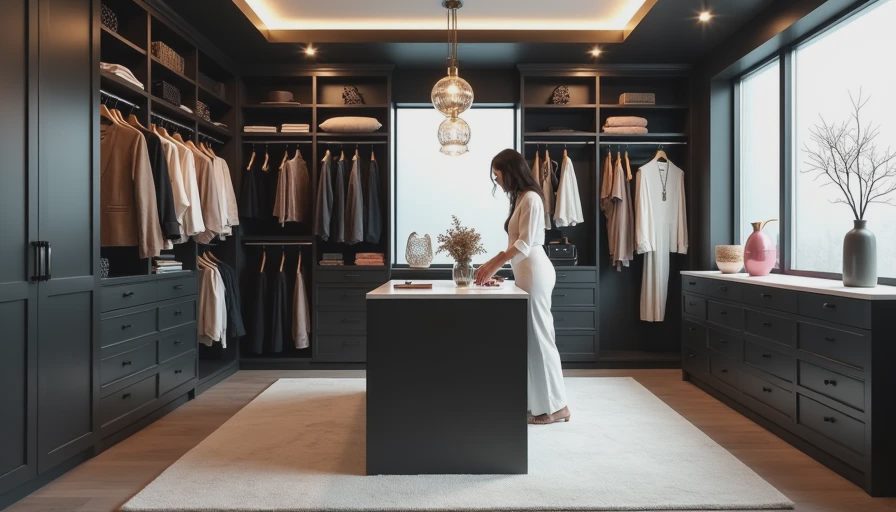
A decorative chandelier can work in a large closet, but it should not hang where coats, garment bags, or raised arms can hit it. Check the fixture height against the ceiling and keep the walking path clear. In a standard 8-foot room, a low-profile flush mount is usually safer than a pendant over the main aisle.
Recessed LEDs offer a clean appearance, but avoid placing them so close to the wall that cabinet tops create a dark strip. Adjustable gimbal fixtures are useful when shelves or a mirror may move later. Surface-mounted linear fixtures are often easier to service and can spread light more evenly than multiple small spots.
LED tape is excellent for shelves, but cheap strips can show individual bright dots and fail at the adhesive. Use an aluminum channel with a diffuser, especially beneath eye-level shelves. Specify a plug-in or low-voltage system only where the outlet and driver remain accessible. Hardwired work should be completed by a licensed professional according to local requirements.
A practical installation checklist
Before closing the walls, confirm every location against the actual closet plan. Measure the finished shelf heights, not just the rough drawing. A light under a 72-inch shelf may be perfect for shirts but useless for a 60-inch shoe shelf if the beam lands behind the shoes.
Check that the door does not collide with a switch, pendant, or mirror. Confirm that the circuit can handle the planned fixtures and that dimmers are compatible with the LED drivers. Test one sample fixture in the room before ordering thirty feet of tape light. Stand at the mirror, open the drawers, and inspect a dark jacket under the proposed color temperature.
Finally, label the lighting circuits in the electrical panel and leave access to every driver or junction box. I once reviewed a closet where the installer placed the LED transformer behind a permanent shoe tower. The light looked fine for six months. When it failed, the owner had to remove half the tower to reach a $40 component.
The most dependable walk in closet lighting ideas are not the flashiest. They make the rods, shelves, drawers, and mirror usable without glare, dead corners, or expensive rework. Plan the electrical bones first, layer the light, use high-CRI LEDs, and test the room with your actual wardrobe before the final installation. That is how a closet works at 6:15 AM, not just in a staged photograph.


No comments yet — be the first to share a thought.