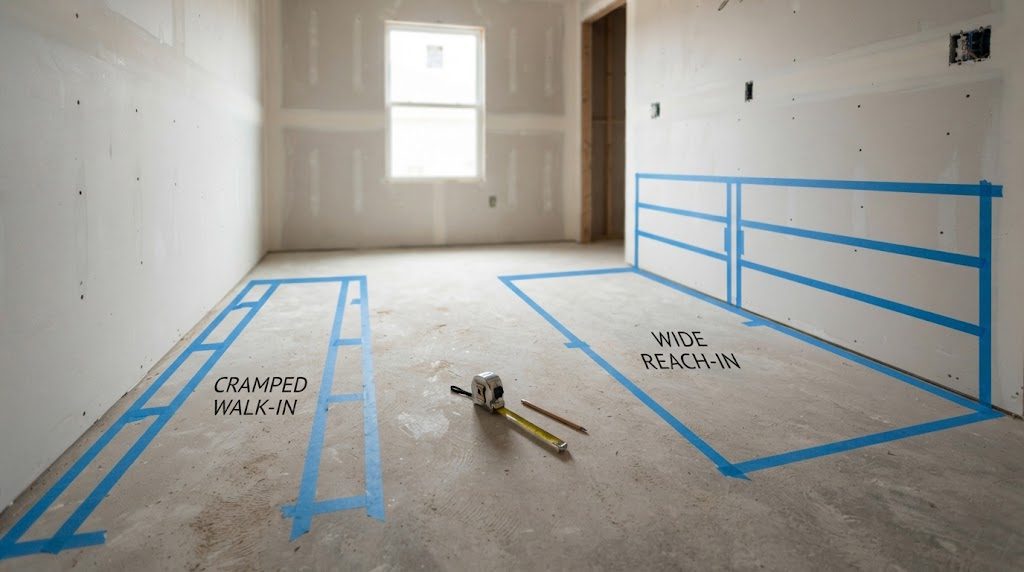
Walk-in closets carry a certain status. The phrase alone sounds luxurious — a room just for getting dressed, with space to turn around, maybe an island, maybe a chandelier. But here's what showrooms won't tell you: most walk-in closets are too small to function properly, and the people who own them wish they'd built a reach-in instead.
Your square footage decides which one you get. Not your wish list, not your Pinterest board. The numbers don't lie, and they're not negotiable. Let's look at the minimums, the math, and the aisle-width rule that changes everything.
The Hard Truth About Walk-In Closet Dimensions
A walk-in closet requires clear floor space to, well, walk in. That sounds obvious, but it's the first thing forgotten when homeowners try to squeeze a walk-in into a bedroom corner. You need enough room for hanging depth, an aisle, and a human body moving through that aisle without scraping shoulders on both walls.
The Minimums That Matter
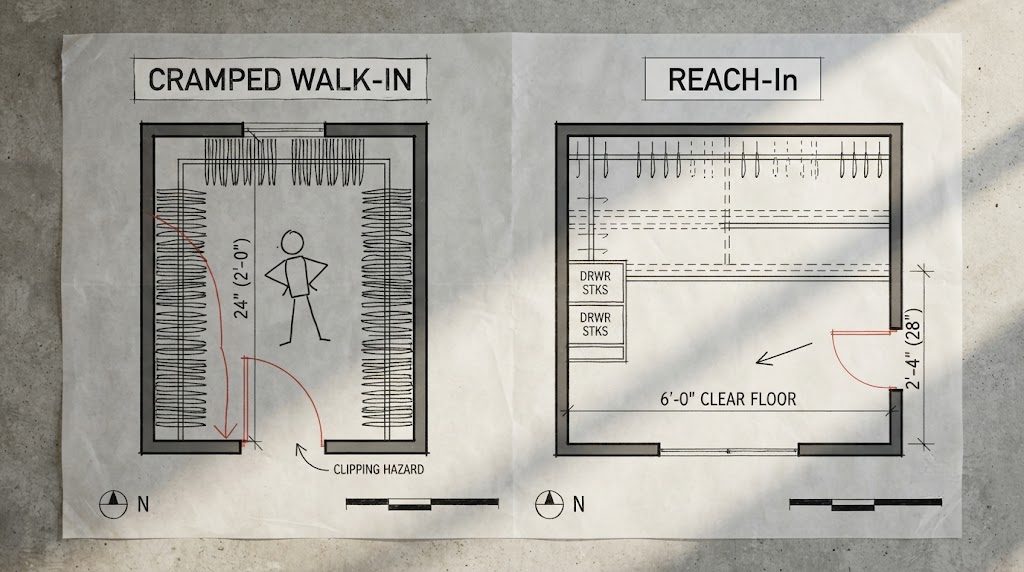
For a closet with hanging on only one side, you need an interior clear width of at least 5 feet. That's 24 inches of hanging depth plus a 36-inch aisle. If you want hanging on both sides — which is the whole point of a walk-in for most people — you need a minimum clear width of 7 feet. That's 24 inches of hanging on each side and a 36-inch aisle down the middle. Seven feet. Not the room's exterior dimensions, not the measurement before drywall. Seven feet of clear, usable width between finished walls.
Depth matters too. A walk-in with a single hanging section on the back wall needs at least 4.5 feet of clear depth to let you stand in front of the rod and step back. Less than that, and your hangers push against the wall when you try to browse.
The 36-Inch Aisle That Changes Everything
Thirty-six inches is the magic number for a single-user walk-in closet. It lets you bend over to reach shoes on a lower shelf, pull a coat off a rod without elbowing the opposite wall, and turn around without a three-point maneuver. If two people use the closet at the same time, 36 inches becomes 48 inches minimum. That extra foot is the difference between a peaceful morning and a daily collision.
Many so-called walk-ins I've measured offer only 28 or 30 inches of aisle. The owners didn't plan to build a cramped closet; they just didn't subtract wall thickness, door swing, and hanging depth from their total square footage. A 6-foot-wide room sounds promising until you frame the walls, hang drywall, install 24-inch-deep shelving on both sides, and realize you've left yourself a 22-inch slot to stand in. You can't get dressed in a hallway.
When a Well-Designed Reach-In Wins
If your available space is less than 7 feet wide, stop trying to build a walk-in. You don't have one. What you have is a reach-in that's asking to be done brilliantly.
The Double-Door Reach-In That Stores More
A 6-foot-wide reach-in closet with double doors, fully built out with double and triple hanging zones, stores more clothing than a cramped walk-in of the same footprint. Why? Because a reach-in has no aisle. Every square inch of its depth — usually 24 inches — is storage. A walk-in of the same total room size gives at least 36 of those inches to an aisle and only 24 inches on each side to storage. Do the math: a 6-by-8-foot room as a walk-in yields roughly 24 linear feet of hanging if you stretch it. A reach-in along an 8-foot wall with two levels of hanging gives you 16 linear feet of hanging in a single tier — times two levels, you're at 32 linear feet. And you haven't lost any floor space to an aisle you can barely use.
A well-designed reach-in with integrated drawers, shoe shelving at the bottom, and dedicated long-hang space on one side can outperform a walk-in that's fighting its own footprint. Add good lighting, a full-length mirror on the facing wall, and a valet rod, and the daily experience is smoother than a cramped walk-in where you have to step sideways to reach your shirts.
Before you decide, measure your clear width and depth. If you can't give that closet a full 7 feet of width and a 36-inch aisle, don't build a walk-in. Build the best reach-in you've ever seen. Your wardrobe won't know the difference, but your morning routine will.



No comments yet — be the first to share a thought.