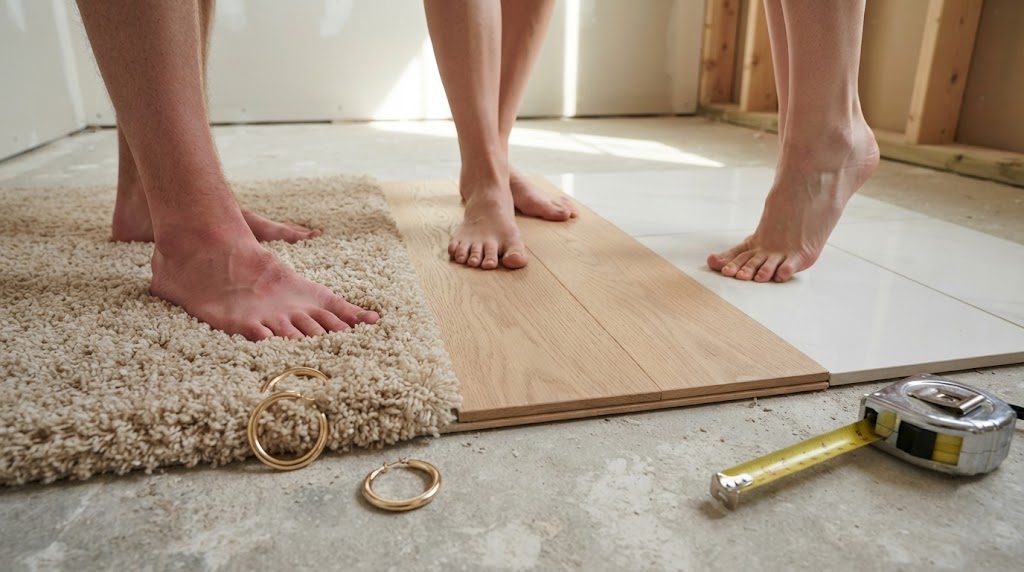
I've pulled carpet out of closets that looked ten years older than the rest of the house. I've seen hardwood scarred by hairspray overspray and tile that turned a dressing room into an echo chamber. Closet flooring is the most overlooked surface in residential design, and it takes more abuse than anyone admits.
You stand on it barefoot every morning. You drop earrings on it. You spill setting spray, knock over a water bottle, track in whatever was on the soles of yesterday's shoes. And unlike a bedroom floor, you're often standing in one spot for several minutes — looking at your reflection, buttoning a shirt, deciding between two pairs of pants. What's under your feet matters.
Here's the verdict, material by material, drawn from real closets I've measured, renovated, and occasionally rescued.
Carpet: The Eight-Out-Of-Ten Mistake
In eight out of ten houses, carpet in a closet is a mistake. Let me tell you why.
What Carpet Gets Wrong
Carpet traps dust, lint, and the fine particulate matter that sheds from clothing fibers. In a room filled with fabric, that's a compounding problem. It also hides small dropped items — the back of an earring, a collar stay, a pill you knocked off a shelf at 6:15 AM. You'll spend time on your hands and knees feeling through pile when you should be walking out the door.
Then there's the humidity factor. Oklahoma City summers push moisture into every room. In a closet with poor ventilation, carpet holds that moisture. Over years, it can develop a musty odor that transfers to the hems of long coats and dresses hanging near the floor. I've walked into closets that smelled like a basement, and the culprit was always carpet padding that never fully dried.
The One Exception
If your closet is a fully converted bedroom on a second floor with excellent HVAC and you genuinely want warmth underfoot, a low-pile wool carpet with no pad can work. It won't trap hairpins, and it breathes. But this is the exception. If you're building from scratch, don't default to carpet.
Tile: Cold, Hard, and Honest
Porcelain and ceramic tile are durable, spill-proof, and easy to clean. They're also unforgiving at 6 AM when the thermostat hasn't kicked in yet. A tile floor in a closet is a cold shock to bare feet, and if you drop a glass bottle of perfume on it, you'll be finding shards for weeks.
Where Tile Makes Sense
Tile works in two scenarios. First, if your closet shares a floor with an adjacent bathroom and you're continuing the same tile through for visual continuity. Second, if you're building in a slab-on-grade situation where moisture is a concern. In those cases, go with a matte-finish porcelain with a slight texture — nothing glossy, nothing that shows every footprint. And absolutely install radiant heating underneath. The cost per square foot in a small closet is manageable, and your feet will thank you every winter morning.
Hardwood: Beautiful But Vulnerable
Hardwood looks gorgeous in a closet. It elevates the room instantly. But hardwood in a closet faces risks it doesn't face in a hallway or living room. Hairspray settles on the finish. A spilled bottle of nail polish remover strips it. High heels worn on the same spot every morning create divots over time. And if your closet has a window, UV light will fade the exposed area while the section under your hanging clothes stays dark, leaving a permanent two-tone floor.
If you're set on hardwood, use an engineered product with a tough factory finish, and add a protective mat where you stand most often. But know going in: this floor will need more maintenance than the hardwood in your bedroom.
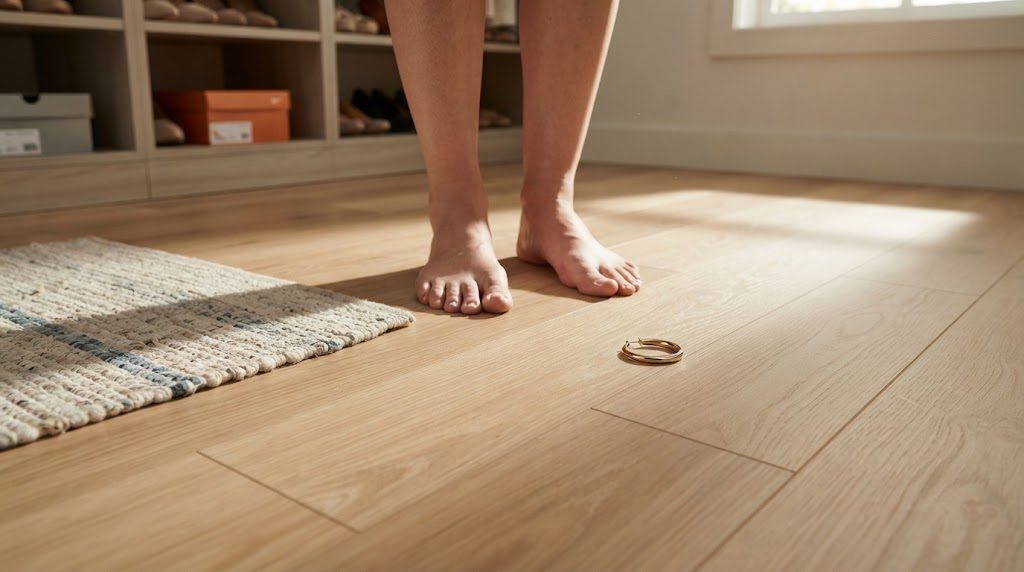
The Designer's Actual Pick: Luxury Vinyl Plank
I don't say this to be trendy. I say it because luxury vinyl plank solves more closet problems than any other material. It's warm underfoot — not carpet-warm, but never cold like tile. It resists spills, doesn't trap dust, and won't scratch if you drop a heavy shoe. If an earring falls, you can see it. If setting spray settles on it, you can wipe it up with no trace. High-quality LVP with a textured wood-look finish gives you the appearance of hardwood without the vulnerability.
I've specified it in over half the custom closets I've designed in the last four years. None of those clients have called me to complain about the floor. That's the best endorsement I can give.
Flooring is permanent in a way that shelving isn't. You can swap hardware, adjust rod heights, reconfigure drawers. You can't change the floor without emptying the entire closet and moving out for a week. Get this decision right the first time, and your closet will reward you every morning — starting with the moment your bare feet hit the floor.
No comments yet — be the first to share a thought.