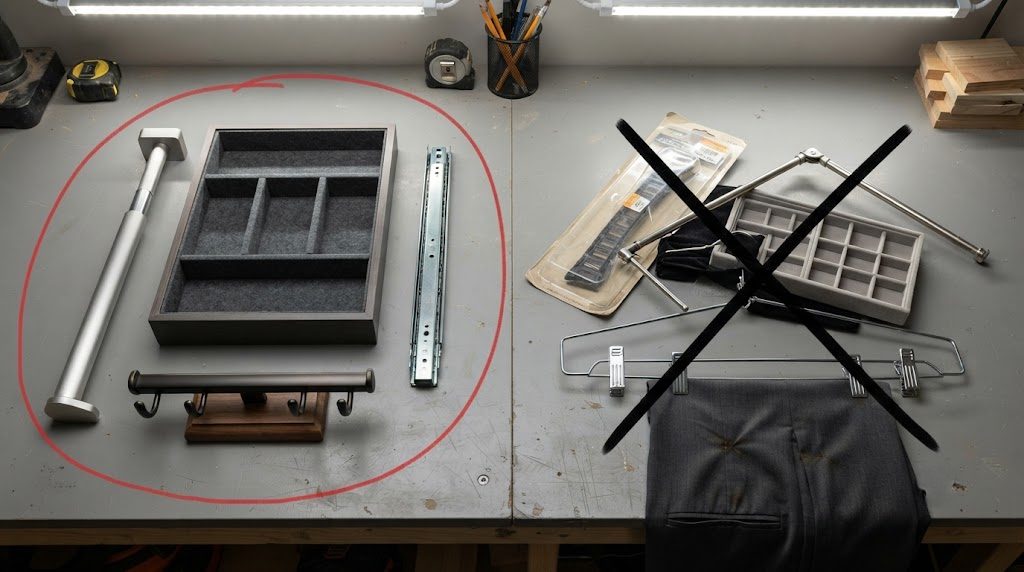
Closet hardware is where budgets go to die. The showroom displays are seductive: a pull-out valet rod that disappears when you don't need it, a velvet-lined jewelry drawer with a compartment for every ring, a chrome tie rack that spins. Each item adds fifty dollars here, a hundred dollars there. By the time you've checked every box on the accessories order form, you've added fifteen hundred dollars to a project — and half of it will sit unused or break within eighteen months.
I've specified this hardware for real clients, watched them live with it, and replaced the failures. Here's the honest breakdown, item by item.
The Hardware That Earns Its Price
Soft-Close Drawer Slides
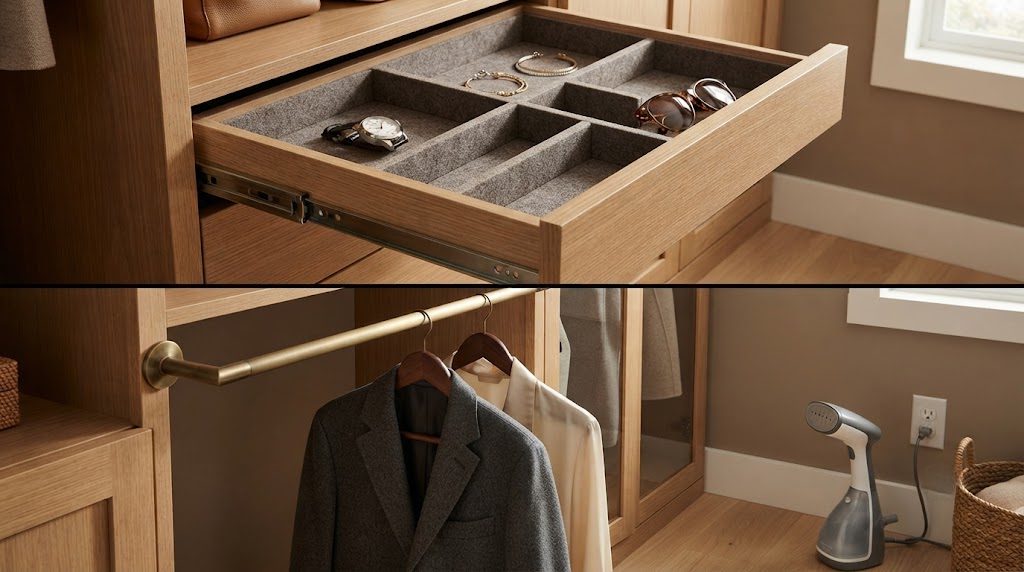
This is the one upgrade I will never compromise on. Soft-close slides prevent drawers from slamming at 5:45 a.m. when someone else is still asleep. They also protect the drawer box and the face frame from impact damage over time. Undermount soft-close slides with a 75-pound weight rating are the standard I specify for every drawer in every closet. Blum and Grass are the brands I trust. The cost difference between standard side-mount slides and quality undermount soft-close is roughly $20 to $30 per drawer. Pay it. You'll use these every single day, and the quiet is worth far more than the money.
Felt-Lined Drawer Dividers
Adjustable dividers wrapped in felt or lined with cork turn a standard drawer into a jewelry and accessories vault. The key word is adjustable. Fixed dividers assume your collection never changes. Adjustable ones let you reconfigure as your accessories evolve. Look for dividers with a solid wood or metal core and a non-slip bottom. Avoid dividers made entirely of acrylic — they crack at the corners within a year. A single well-divided drawer for watches, bracelets, and sunglasses does more for your morning routine than an entire jewelry armoire.
The Valet Rod
A valet rod is a short horizontal rod that pulls out or folds down from a closet panel, giving you a temporary hanging spot for the outfit you're planning to wear, the dry cleaning you just picked up, or the jacket you're steaming. It's one of the simplest pieces of hardware in a closet, and it gets used more than almost anything else.
Buy the fixed valet rod, not the retractable one. The retractable models with a scissor mechanism fail at the hinge. I've replaced too many of them. A fixed, solid brass or stainless steel rod mounted to the side of a cabinet panel costs $40 to $80 and will outlast the closet. Mount it at roughly 40 to 48 inches from the floor, near an outlet if you use a steamer. Your mornings will thank you.
The Hardware You'll Never Use
Tie and Belt Racks That Spin
The spinning chrome tie rack looks clever in the store. In practice, it holds twelve ties in a space that could hold twenty folded ties in a shallow drawer, and the spinning mechanism loosens over time until the whole thing droops at a sad angle. Belt racks that hang from a rod and hold belts by the buckle suffer the same fate, and they jingle every time you brush against them. Store belts coiled in a drawer with dividers. Store ties folded over a drawer insert or a valet rod. Skip the spinning rack.
The Shoe Carousel
Motorized shoe carousels exist because they look impressive, not because they store shoes efficiently. A carousel takes up a 30-inch diameter of floor space and holds maybe 24 pairs if you arrange them perfectly. An open floor-level shelf 30 inches wide holds the same number of pairs at zero mechanical risk. The motorized carousel will break. When it breaks, it becomes a stationary pile of shoes you can't easily access. I've never specified one. I've removed two.
Drawer-Within-a-Drawer Inserts
The velvet-lined top drawer with smaller hidden drawers underneath sounds luxurious. In practice, the small drawers underneath hold very little, and you have to remove everything from the top drawer to access them. If you want hidden storage, put a locking drawer at the bottom of the stack for valuables. The drawer-within-a-drawer is theater.
Before you check a single box on the hardware order form, ask one question: will I touch this at least once a week? If the answer is no, it's not hardware. It's decoration. And decoration is fine — just know you're paying for it.




No comments yet — be the first to share a thought.