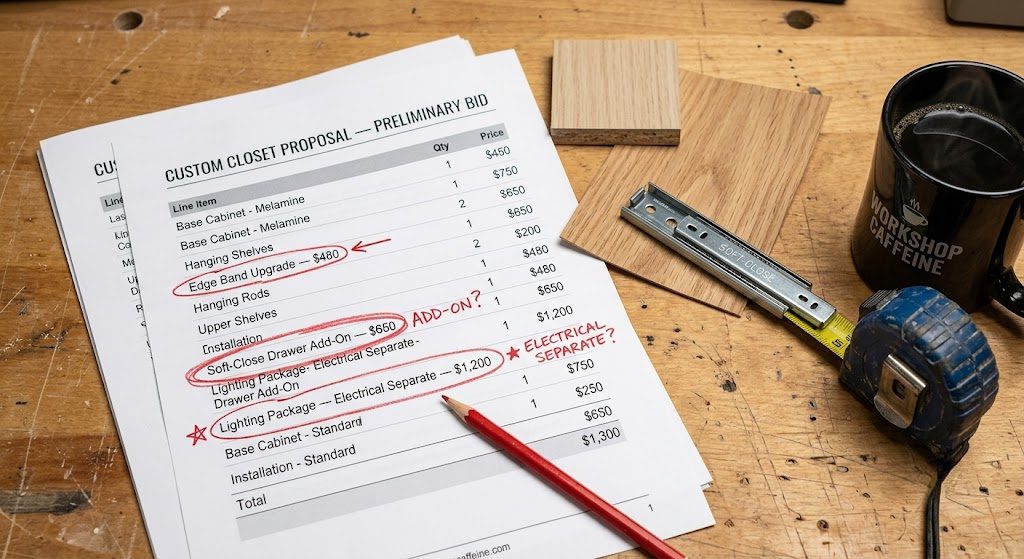
A custom closet bid lands in your inbox as a PDF. It's six pages long. There are forty-seven line items, each with a code you don't recognize, a quantity that seems arbitrary, and a unit price that may or may not include installation. The total at the bottom is $2,500 more than the salesperson mentioned during the consultation. You stare at it. You don't know which lines are standard, which ones are marked up, and which ones you can remove without ruining the design.
I've read dozens of these bids — from national chains, regional fabricators, and independent shops. I've written some of them myself. I know where the money hides. Here's how to read a custom closet proposal line by line, what to question, and where the upcharges live.
How the Bid Is Structured
Most custom closet proposals follow the same format, regardless of the company. The bid is divided into sections that follow the room: Wall A, Wall B, Wall C, Island, Accessories, Electrical, Installation. Within each section, every shelf, drawer, rod, panel, and trim piece is listed as a separate line item with a part code, quantity, unit price, and extended price.
The first thing to check is whether the line items are grouped by wall or by material type. Grouping by wall is standard and makes sense — you want to see what each section of the closet costs. If the bid is grouped by material type instead (all melamine panels together, all drawer slides together, all trim pieces together), it's harder to see what you're paying for each section, and it's easier for upcharges to hide in the aggregation. Ask for a wall-by-wall breakdown. Most companies will provide it if you ask.
The Part Codes
Those alphanumeric codes next to each line item — something like "SH-2436-W-MEL" — are not random. They typically encode the item type, dimensions, color, and material. "SH" is shelf. "2436" is 24 inches by 36 inches. "W" is white. "MEL" is melamine. Once you crack the code, the bid becomes readable. Ask the salesperson for a key to the part codes. If they won't provide one, that's a red flag.
The Upcharges: What's Standard, What's Marked Up
Edge Banding
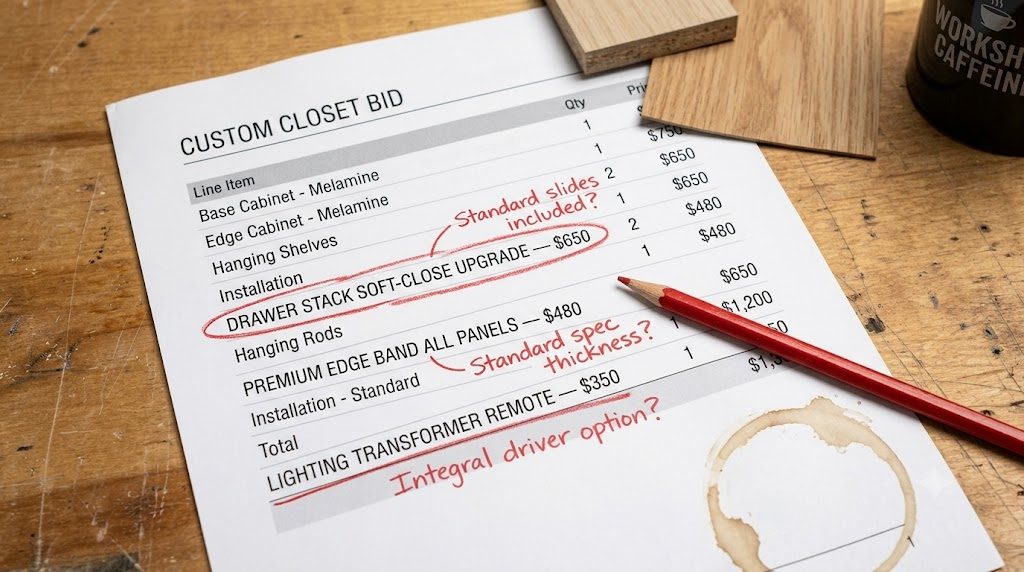
Edge banding is the strip of material applied to the cut edges of melamine or veneer panels. Standard edge banding is typically a thin PVC band — 0.5mm to 1mm — in a color matched to the panel face. This is included in the base price of most custom closet systems. If the bid has a separate line item for "Edge Band Upgrade" or "Premium Edge Band," ask what the standard spec is and what the upgrade provides. A 2mm or 3mm edge band is more durable and looks more substantial, but it shouldn't add more than 5 to 8 percent to the panel cost. If the upgrade line is $400 or more for a standard closet, you're paying too much for a slightly thicker strip of plastic.
Soft-Close Drawer Slides
Soft-close slides are worth the money. But they shouldn't be a surprise. Some bids list drawers with standard side-mount slides and then add soft-close as a separate line item further down, effectively charging for the slides twice. Ask whether soft-close is included in the drawer price or billed separately. A quality custom closet company includes soft-close undermount slides as standard on all drawers. If they don't, the upgrade should cost roughly $25 to $40 per drawer pair, not $75 or $100. Anything above that is margin.
Lighting as a Separate Electrical Line
This is one of the most common upcharge tactics. The salesperson specs integrated LED shelf lighting, puck lights, or a lighted hanging rod, and the lighting shows up on the bid under a separate section labeled "Electrical" with its own line items for transformers, drivers, wiring, and labor. This separation is legitimate — lighting installation often requires a licensed electrician — but the markup can be aggressive. Ask for the lighting quote to include the specific fixture models and driver specifications. Then price those fixtures online. If the fixture cost on the bid is double the retail price, negotiate. If the labor line says "Electrical — $1,200" with no breakdown of hours or hourly rate, ask for one.
Installation
Installation is typically 15 to 25 percent of the total cabinetry cost. It should be a single line item or a clear percentage. If installation is broken into multiple vague lines — "Cabinet Install," "Trim Install," "Hardware Mounting," "Final Adjust" — the company is padding. Installation is one job performed by one crew over one or two days. It should be one line.
The Line Items You Can Cut
Pull-Out Accessories You Won't Use
Pull-out tie racks, belt racks, and jewelry trays look impressive in the showroom and collect dust in the closet. If a pull-out accessory is listed at more than $100 and you don't use the item it's designed for daily, cut it. You can add a freestanding jewelry tray or a drawer insert later for a fraction of the cost.
Crown Molding and Light Valances
Crown molding at the top of the closet system and light valances that conceal under-shelf lighting are aesthetic upgrades. They make the closet look more built-in and finished. They also add $400 to $1,200 depending on the room size. If you're working with a tight budget, these are the first things to cut. The closet functions identically without them. You can add crown molding later with a separate carpenter for less than the closet company charges.
The Question That Saves You Money
Before you approve any custom closet bid, ask the salesperson one question: "If I needed to reduce this total by 20 percent without losing any storage capacity, what would you change?"
This forces the salesperson to identify the markup items themselves. They know where the padding is. They might suggest downgrading from veneer to melamine on interior panels that don't show, or switching from solid wood drawer fronts to veneered MDF, or eliminating the light valances. Let them tell you what's negotiable. You'll learn more about the bid from that one question than from an hour of studying the line items.
A custom closet bid is a negotiation, not a menu. The prices are not fixed. The upgrades are not all necessary. The lighting package is not the only option. Read the bid line by line. Question every separate charge. And never pay for a pull-out tie rack you won't use.



No comments yet — be the first to share a thought.