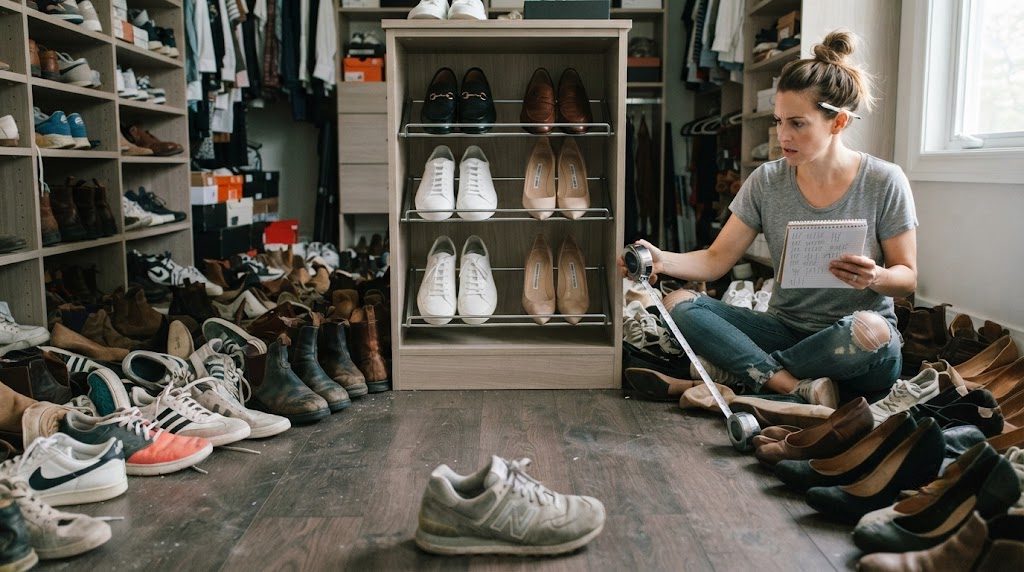
Every shoe storage product on the market assumes you own the shoes that fit in it. That's not a design flaw. It's a sales strategy. The slanted shelf displays heels beautifully. The cubby grid fits exactly twelve pairs of flats. The pull-out rack is perfect for sneakers — if your sneakers are exactly the size the rack was designed for.
But your shoe collection isn't a product demo. It's an accumulation of choices made across years: the winter boots you bought in a snowstorm, the running shoes that replaced last year's running shoes, the heels you wear twice a year but refuse to donate. That collection has dimensions. And until you measure those dimensions, every storage solution is a guess.
Count First, Buy Second
Before you look at a single shoe shelf, do a real inventory. Take every pair of shoes you own and put them on the floor. Count them. Then measure the tallest pair, the widest pair, the longest pair. This is your actual shoe data. Most people underestimate their total by thirty percent. They forget the boots in the hall closet, the sandals under the bed, the gym shoes in the trunk of the car. Get them all in one room. Write the number down.
Now look at the storage system you're considering. If a slanted shelf rack holds 18 pairs and you own 27, you need to either buy two racks or accept that nine pairs will live somewhere else. That sounds obvious. But I've walked into dozens of closets where the shoe storage was purchased before the count, and the overflow ended up in a pile on the closet floor. The pile is not a design decision. It's what happens when the math doesn't work.
The Four Storage Types, Honestly Assessed
Slanted Shelves: Beautiful, Wasteful
Slanted shelves display shoes like a boutique, and they work brilliantly for heels and flats. But they waste vertical space. A slanted shelf requires roughly 8 to 10 inches of height per row, and a row holds shoes heel-down, toe-up at an angle. If your ceiling is 8 feet, you might get five or six rows. That's fine for a curated collection of 20 pairs. It's useless for 50 pairs of mixed footwear including boots. Slanted shelves are for the shoes you want to see, not the shoes you need to store.
Cubbies: Measure the Opening
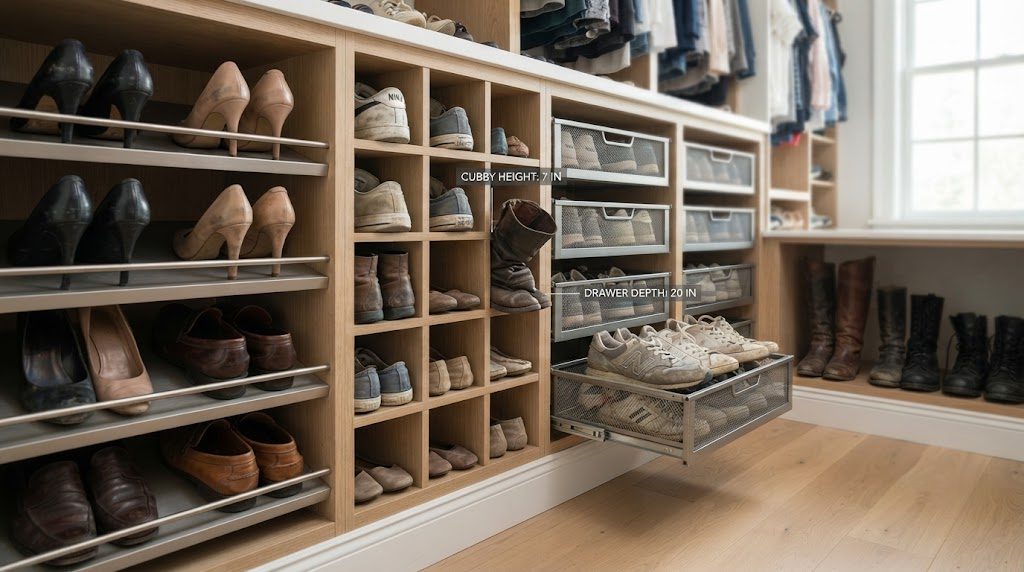
Cubbies are versatile, but the standard 6-inch or 8-inch cubby opening doesn't fit everything. Ankle boots need at least 10 inches of height. Knee-high boots need 16 to 18 inches of vertical clearance, or they need to be stored flat or hung. Before you commit to a cubby system, measure your tallest pair of shoes and confirm the cubby opening clears it by at least an inch. If it doesn't, those shoes will live on the floor no matter how nice the cubbies look.
Pull-Out Racks: Clearance Is Everything
Pull-out shoe racks mounted on drawer slides are excellent for sneakers, flats, and daily-wear shoes. But they require clearance. The drawer itself needs depth — at least 14 inches for men's shoes, 12 inches for most women's — and the aisle in front of the rack needs enough room for the drawer to fully extend. That's roughly 24 to 28 inches of clear floor space in front of the rack. If your aisle is 30 inches and you install a 14-inch-deep pull-out rack, you'll be standing between the open drawer and the opposite wall with no room to bend down. Measure the aisle. Measure the drawer extension. Add your body. Do the math.
Floor-Level Storage: The Most Underrated Option
The bottom 12 inches of your closet is prime real estate for shoes you wear daily. An open shelf at floor level, no doors, no drawers, just a clear space with a low lip, holds the shoes you kick off and step into every day. It's not elegant. It's functional. And it keeps those shoes off the floor without requiring you to open anything. I've put a 6-inch-high open shelf along the bottom of hanging sections in almost every closet I've designed in the last three years. Clients use it. The floor stays clear.
The right shoe storage isn't the one that looks best in a showroom. It's the one that fits the number, the heights, and the daily rhythms of the shoes you actually own. Count them. Measure them. Then shop.



No comments yet — be the first to share a thought.