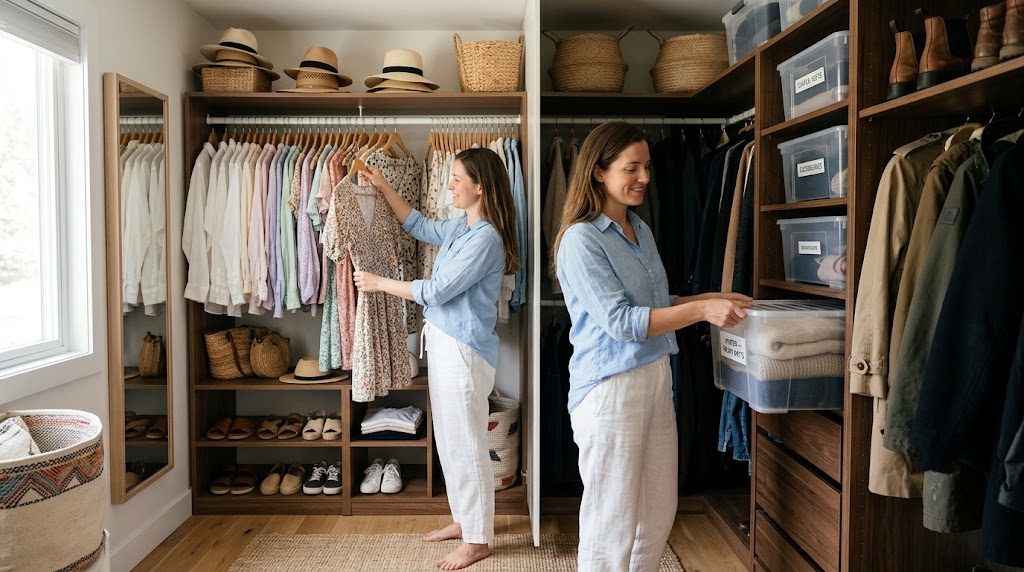
Most seasonal rotation advice assumes you have an attic, a basement, a guest room closet with nothing in it, and a full Saturday to devote to The Big Swap. You don't. What you have is a closet that needs to hold two climates, a weekend you'd rather spend doing anything else, and a growing suspicion that the "off-season storage bin in the garage" is ruining your leather boots.
I live and work in Oklahoma City, where summer runs from May through October and winter arrives in November and overstays until March. That's not a closet problem you solve by vacuum-sealing half your wardrobe and hauling it to the attic twice a year. It's a problem you solve by designing the rotation into the closet itself.
The Seasonal Zone System
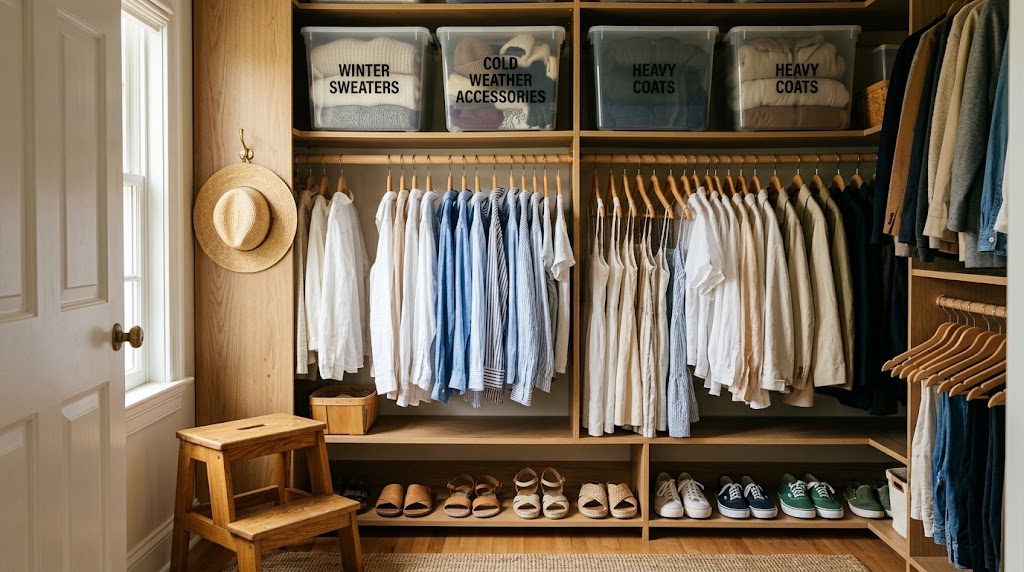
Your closet has vertical zones. The ones you touch daily should hold what you wear now. The ones you need a step stool to reach should hold what you'll wear in six months. This sounds obvious, but most closets do the opposite: off-season clothes get buried in under-bed bins while prime real estate holds things nobody has touched since last year.
High Storage for Off-Season
The top shelf of a closet — roughly 76 to 84 inches from the floor — is difficult to access on a daily basis. That makes it perfect for off-season storage. Use clear, lidded bins with labels facing outward. Clear bins let you see what's inside without opening them. Labels tell you the category: "Winter Coats," "Summer Sandals," "Heavy Sweaters." Do not use cardboard boxes. Cardboard attracts pests, absorbs moisture, and hides its contents. Clear plastic bins with secure lids cost maybe twelve dollars each and protect your clothes through a humid Oklahoma summer.
Mid-Level for Current Season
Everything between roughly 30 and 74 inches from the floor is your active zone. This is where current-season hanging clothes and folded items live. If it's July, your linen shirts, cotton dresses, and lightweight trousers occupy the prime hanging rods. Your wool coats are in labeled bins on the top shelf. The active zone should feel spacious because half your wardrobe isn't in it. That's the point.
Low Storage for Shoes and Heavy Items
The bottom 12 to 24 inches holds shoes, boots, and heavy folded items like denim. Shoes you wear this season sit on open shelves or in pull-out racks at floor level. Off-season shoes go in clear bins on the top shelf or in a dedicated shoe cabinet if you have the footprint. Boots need special attention — store them upright with boot trees or rolled magazine inserts to maintain their shape, never folded or crushed under other items.
The Rotation Rhythm That Actually Works
The "twice a year total swap" is a fantasy for most people. Here's what works better: partial rotation by weather trigger.
The Two-Week Overlap
When seasons shift in Oklahoma, they don't flip a switch. October has 80-degree days and 45-degree nights. April does the same thing in reverse. Your closet needs a two-week overlap period where both seasons coexist in the active zone. Dedicate one small section — a single rod or a few shelves — to transitional pieces that bridge the gap. A lightweight cardigan, a denim jacket, closed-toe flats. These items stay accessible year-round because they work in both climates.
The actual swap happens gradually. On the first 90-degree day in May, move the heaviest wool sweaters to the top-shelf bins. On the first frost in November, bring them back down and send the linen upstairs. This isn't a single exhausting Saturday project. It's a few minutes on a Sunday afternoon, triggered by the weather, not the calendar.
The One-Year-Untouched Rule
Here's the only decluttering rule I enforce: if an item hasn't been worn in twelve months and it has passed through its season in the active zone, it leaves the closet. Not necessarily your life — if it's sentimental, store it somewhere else. But it doesn't get to take up square footage in a room that has to perform every morning. Seasonal rotation makes this rule easy to enforce, because you handle every item in your wardrobe at least twice a year.
Your closet doesn't need a second room for off-season storage. It needs vertical zones, clear bins, a sturdy step stool, and a rotation rhythm that follows the weather, not a Pinterest-perfect seasonal swap weekend. Design the system first. The clothes will follow.





No comments yet — be the first to share a thought.