
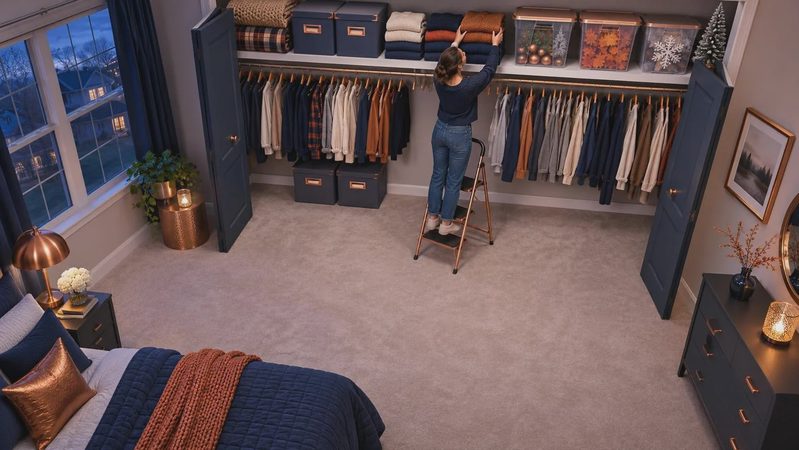
The answer to how to use space at top of closet is to make it a landing zone for lightweight things you don't need every morning: off-season clothes, spare bedding, and empty luggage. Start with a properly supported shelf, leave room to get containers down safely, and keep lights, vents, and doors clear. A tall closet is useful only if you can reach its contents without balancing on a hanger rod.
Measure the room before adding storage
Stand inside the closet with the door closed and look up. Note the door swing, ceiling light, sprinkler head if there is one, air vent, attic access panel, and any sloped ceiling. A shelf that covers an access panel or puts a pile of bedding against a light fixture is not an upgrade.
Measure the width and depth of the available wall, then the distance from the proposed shelf to the ceiling. Also measure the opening through which a bin has to pass. In a reach-in closet, the wall above the door opening can make a tall container impossible to lift out even when it fits on the shelf.
For a walk-in, I like to plan around a clear aisle of about 36 inches where the room allows it. Measure from the front edge of stored items or hanging clothes, not just from the wall. A deep overhead shelf that protrudes into an already narrow aisle can make the closet feel smaller every time you walk in.
Mark shelf height with painter's tape and hold an empty box at that level. Can you lift it onto the shelf without twisting around the door or hitting the ceiling? That quick check is worth doing before ordering a board.

How to use space at top of closet for the right items
Treat high storage like the back row of a cabinet: it should hold things you need occasionally, not things you use on a Tuesday morning. Sweaters between seasons, guest linens, and soft travel bags make sense. Heavy shoe collections, frequently worn jeans, and a stack of loose handbags do not.
Group items by retrieval date. Put winter scarves and hats in one container, for example, rather than splitting them between three bins based on color. A label on the outward-facing side saves you from pulling everything down to find one thing.
Choose containers you can lift comfortably with two hands. Several smaller bins are usually easier to handle than one oversized tote, especially if you're standing on a step stool. Soft-sided zippered bags can work for blankets, but don't pack them so tightly that they become awkward or heavy. Keep delicate garments clean and dry, and check their care labels before storing them for a long stretch.
Empty suitcases can earn their footprint by holding lightweight travel accessories. Don't fill a large suitcase with dense clothing and then expect to hoist it overhead safely. If a case won't clear the opening without a struggle, store it somewhere lower.
Build a shelf that can carry the load
A shelf is only as reliable as its supports. Locate and mark the studs before deciding where brackets or wall cleats will go. Drywall alone is not a dependable place to hang a heavily loaded storage shelf. Attach supports to framing using hardware appropriate for the wall and the expected load; if the framing isn't where you need it, have an installer assess the right support method.
Shelf material, span, thickness, bracket spacing, and fasteners all affect how much weight the assembly can carry. Don't assume a board rated for a short span can handle the same load across a long closet. Follow the shelf and hardware manufacturers' instructions, and use the lowest applicable load rating for the complete assembly. When in doubt, add proper support or hire a carpenter.
A shelf around 12 to 16 inches deep is a useful starting point for folded items and modest bins. Measure your actual containers before settling on a depth. Deeper shelves hold more, but they also hide the back row and make overhead lifting harder. Leave a little space above the tallest bin so you can tip it and pull it forward.

Work around light and air
Don't let stored items touch a light fixture, and don't assume a low-heat bulb makes every shelf location acceptable. Closet lighting clearances depend on the fixture and applicable electrical requirements. Check the fixture instructions and local code, and bring in an electrician if you're moving or adding a light.
A shelf can also cast a shadow over the clothes below. Before installation, switch on the existing light and hold a piece of cardboard where the shelf will go. If the hanging area goes dark, solve the lighting plan before the shelf is fixed in place. A relocated or additional properly installed fixture may be more useful than a deeper shelf.
Keep supply and return vents unobstructed. Leave attic or mechanical access usable, too; storage that has to be dismantled for a service call will eventually become a nuisance.
Make high storage reachable and maintainable
A stable folding step stool is better than standing on a chair or pulling against a closet rod. Store the stool nearby, open it fully, and place it on a level floor. If the shelf is so high that you must reach beyond a comfortable position or lift a bulky container over your head, that spot is a poor choice for that item.
For a tall closet, one continuous high shelf is often more practical than two tightly stacked shelves. Two levels sound efficient, but each needs enough clearance for a hand and a container. Before adding a second shelf, measure the usable height of the containers plus the room needed to lift them out.
At the change of season, bring down one category at a time. Put the outgoing items into the emptied containers, check for moisture or dust, and return only what belongs overhead. The goal isn't to fill every inch to the ceiling. It's to give the awkward top of the closet a job that doesn't interfere with the rest of the room.




No comments yet — be the first to share a thought.