
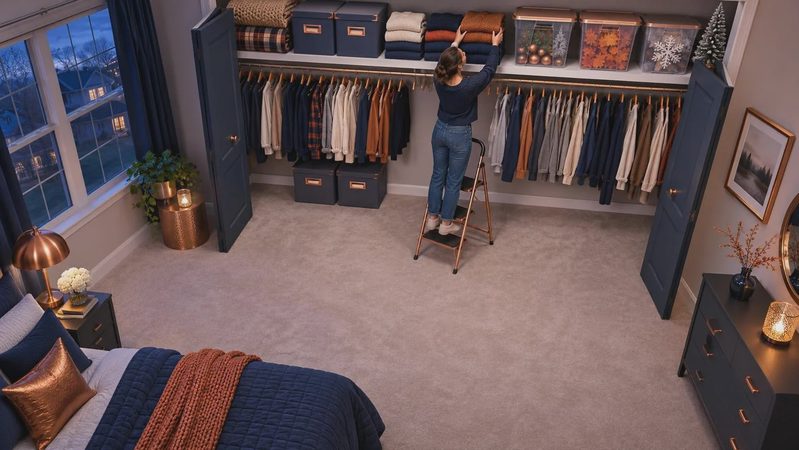
A top shelf big closet layout works best when the high shelf holds things you need occasionally, not the shirt you want before work. Start with a continuous shelf above the hanging sections where the wall and lighting allow it, make it deep enough for your actual bins, and support it for the weight you intend to store. A big room gives you options; it does not make an overloaded shelf easier to reach.
Start with the walls, not the baskets
Before drawing a shelf, measure each wall at the floor, middle, and ceiling. Older rooms are not always square, and a shelf cut to the widest measurement can leave you with an unpleasant installation day. Mark the door swing, window trim, attic access, vents, switches, and outlets on your sketch. A shelf that blocks an access panel is not clever storage.
Find the studs before deciding where shelf standards, brackets, or vertical panels will go. A stud finder is a starting point, not proof: confirm locations with a small probe hole in an inconspicuous spot. Be alert to electrical wiring and plumbing when opening walls or driving fasteners. If you cannot identify what is behind the drywall, get help before drilling.
Also look up. Recessed lights, surface fixtures, and sprinkler heads may limit shelf placement. Do not guess at clearance around a light fixture: check its instructions and applicable local requirements. Never box in or obstruct a sprinkler head; consult the appropriate professional if the layout conflicts with one.
Size a top shelf big closet owners can use
For a shelf above a clothes rod, 12 to 16 inches deep is a useful planning range. Twelve inches can work for folded items and smaller boxes; 16 inches gives larger containers more room but also puts their contents farther from view. Measure your largest intended item before settling on a depth. A deep shelf is wasted if the back half becomes a place where things disappear.

Allow enough height above the shelf for the item and your hand to clear it. A 12-inch-tall bin needs more than a 12-inch opening if you plan to lift it out rather than drag it forward. As a starting point, add several inches of clearance, then test the movement with the actual container. If a ceiling slopes, measure at the back of the shelf as well as the front.
For everyday hanging, plan around the clothes rather than an arbitrary shelf height. A single-hang section often has its rod around 66 inches above the floor, but long dresses and coats may need more. Measure from the hanger hook to the longest hem and add floor clearance. For double-hang sections, shirts and folded-over pants need separate zones; check your longest pieces before fixing the upper rod.
Place the shelf high enough to clear the hangers and leave room to lift them off the rod. The shelf and rod are a pair: moving one affects the other. If your high shelf ends up beyond comfortable reach, that is fine for seasonal storage, but plan where a stable step stool will live.
Support the load, including what you will add later
A long, uninterrupted shelf looks tidy on a drawing. Under a row of full bins, it may sag. The span a shelf can handle depends on its material, thickness, depth, load, and support method. There is no honest universal bracket spacing that covers every installation.
Follow the shelf and hardware manufacturers' span and load guidance, and use the lower applicable limit. For a long run, vertical partitions or additional properly anchored brackets can shorten the unsupported span. Check that the wall attachment and fasteners are rated for the load as well; a strong shelf does little good if its supports pull loose. When the system or wall condition is uncertain, ask the installer or a qualified contractor to assess it.
Keep dense items, such as books or heavy equipment, on lower, well-supported shelves instead. High storage is better suited to light bedding, empty luggage, and seasonal accessories. Even a shelf that can carry a heavy box does not make that box safe to lower from above your head.

Keep the aisle and retrieval route clear
A generous closet can still have a cramped working lane. I aim for at least 36 inches of clear aisle where practical, measured between the items that project farthest into the room, not just between cabinet frames. Hanging clothes, open drawers, hamper pullouts, and an island all eat into that space. More clearance makes it easier to turn with a bin or set up a stool.
Before adding an island, mark its footprint on the floor and open every nearby drawer and door. Then stand a step stool where you would actually use it. If the stool blocks the only path out or forces you to lean sideways toward the shelf, the island is too big or the shelf needs a different access plan.
Use a stable household step stool on a level floor, follow its instructions, and keep your body centered. Don't climb on a drawer, chair, or closet island. For anything too bulky to hold close to your body, get another person to help or find it a lower home.
Decide what earns the upper shelf
Give the highest zone a specific job before buying containers. Out-of-season bedding, spare gift wrap, and lightly packed travel bags are reasonable candidates. Daily shoes, medication, and heavy holiday decorations are not. Frequently used items belong between roughly waist and eye level whenever the layout allows.
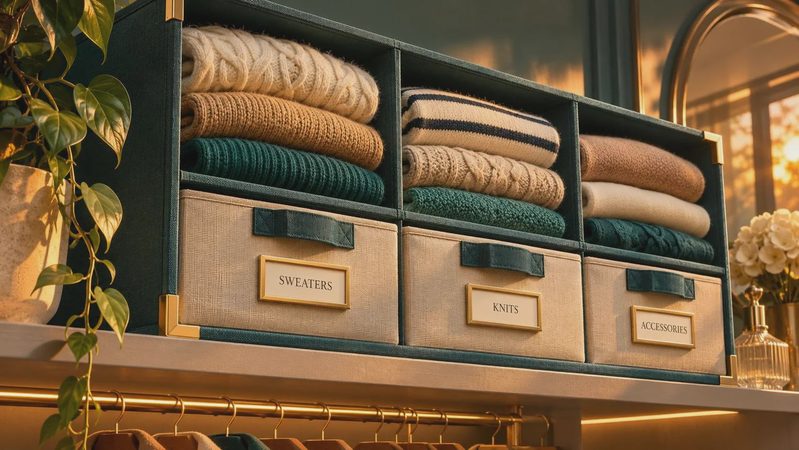
Choose containers you can identify and grip from below. A bin with a front label is easier to sort than a matching stack of mystery boxes. Avoid stacking several heavy containers: removing the bottom one becomes a balancing act. Leave a little open space so you can retrieve one item without shifting the entire row.
Finally, check ventilation and the condition of the room before storing textiles long term. Clean and fully dry clothing or linens before packing them, and address leaks or persistent dampness first. The best top shelf is not the one packed to the ceiling. It is the one you can load securely, see into, and reach without rearranging the rest of the closet.



No comments yet — be the first to share a thought.