
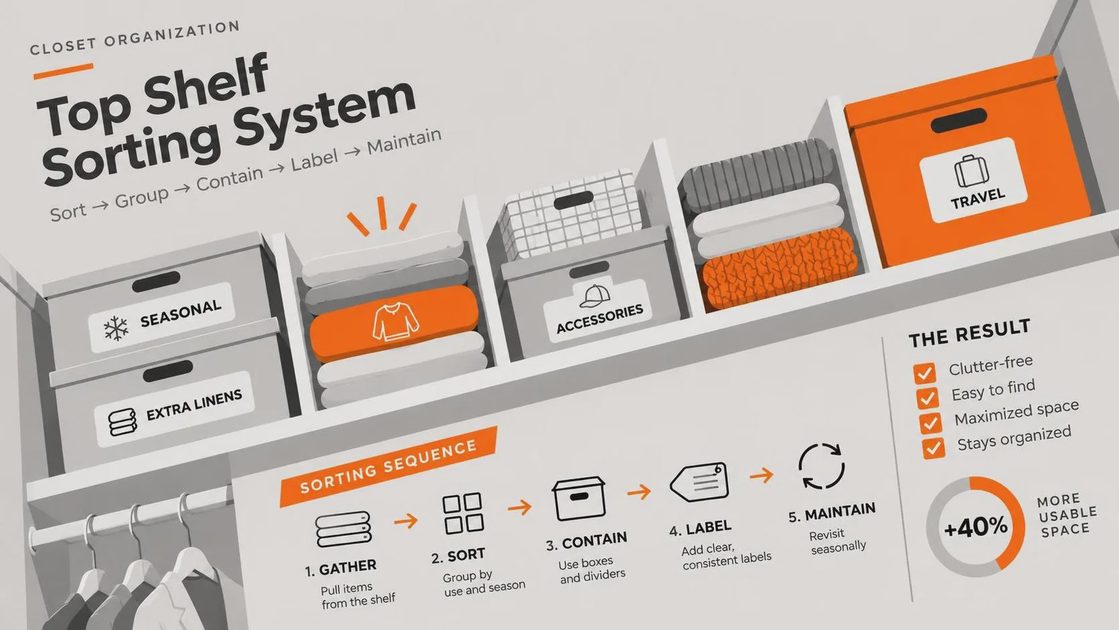
The hardest part of learning how to organize closet top shelf space is accepting that it is not everyday storage. Most top shelves sit 72 to 84 inches above the floor, which puts them outside comfortable reach for daily dressing. Treat them as a controlled storage zone for seasonal clothing, luggage, spare bedding, and items you need occasionally. The goal is not to fill every inch. The goal is to make every stored item findable without pulling down six boxes first.
Before buying containers, check the structure. Measure the shelf depth, the opening width, and the vertical clearance between the shelf and ceiling. A standard closet shelf may be 12 to 16 inches deep, while a custom shelf can be 18 inches deep. That difference determines whether a large lidded bin fits safely or becomes a heavy object hanging over the edge. If the shelf is sagging, loose, or attached only to drywall anchors, fix that before loading it with winter coats.
Start With Weight, Reach, and Shelf Depth
When I organize closet top shelf areas, I put lightweight items in the least accessible locations. Empty luggage, off-season linens, artificial holiday accessories, and spare garment bags are reasonable choices. A box of books, a cast-iron sewing machine, or a dense stack of shoes is not. Weight concentrated at the front edge can damage a shelf and create a falling hazard when you pull the container down.
Keep the most frequently used items closest to the closet entrance or at the front of the shelf. A small step stool should not be necessary for every visit, but it is sensible for anything above shoulder height. Choose a stable two-step stool that can sit outside the closet without blocking the door swing. Do not stand on a storage cube, rolling hamper, or chair with wheels.
For shelf depth, leave roughly 1 inch of clearance at the sides and back of each container. That makes bins easier to remove and prevents a tight fit from turning into a wrestling match. If the shelf is 16 inches deep, a 14-inch-deep bin is usually more practical than a 16-inch bin with a lid that catches on the wall.
Use Containers That Match the Opening
The best container for a top shelf is not automatically the prettiest one. It needs a firm base, a usable handle, and a label you can read from below. Fabric bins work well for sweaters, scarves, and soft accessories, but they collapse when overfilled. Plastic bins protect against dust and attic-like temperature changes, though clear plastic can make a closet look visually busy.
For most reach-in closets, I prefer matching bins in two sizes rather than one oversized box. A medium bin around 12 inches wide is easier to lift than a 30-inch container packed with coats. Use the larger size only when two people can safely move it or when the contents are genuinely light, such as spare pillows.
If you organize closet top shelf storage with opaque bins, label two sides: the front and the end. That matters when containers are turned sideways to fit a narrow opening. Write “winter scarves,” “guest bedding,” or “holiday linens,” not “miscellaneous.” A vague label simply moves the sorting problem into a box.
Avoid cardboard for long-term closet storage. It absorbs humidity, attracts dust, and weakens at the corners. In an Oklahoma City house, I am especially cautious in closets near exterior walls, where seasonal temperature swings can affect paper and fabric. A lidded polypropylene bin or a washable canvas box is a better investment for anything you plan to store for more than one season.
Sort by Frequency Before You Fill the Shelf
A useful top shelf system has three levels of access. The front and center hold items used every few weeks. The sides and rear hold seasonal items. The highest or most awkward corner holds true backup stock, such as extra hangers, spare pillowcases, or an empty duffel bag.
Do not store all clothing by category if that makes retrieval difficult. Instead, group by the time of year and the task. One bin might hold cold-weather accessories, another might hold swimsuit cover-ups and travel pouches, and a third might hold donation bags waiting for a drop-off. The category should answer the question you will ask later: “Where are the things I need for a ski trip?”
If you organize closet top shelf contents by season, keep a short inventory on the inside of the closet door. It can be a handwritten list or a note on your phone. Record the bin location and a few key contents. This is particularly helpful when your wardrobe rotates twice a year and the top shelf contains pieces you have not seen since last winter.
A client once had four identical black boxes labeled only “clothes.” We opened all four to find maternity wear, costume pieces, old uniforms, and sweaters. The boxes were not the problem. The missing inventory was. She replaced the labels, removed two boxes, and recovered enough space for her current travel bags.
Make Seasonal Rotation a Two-Minute Job
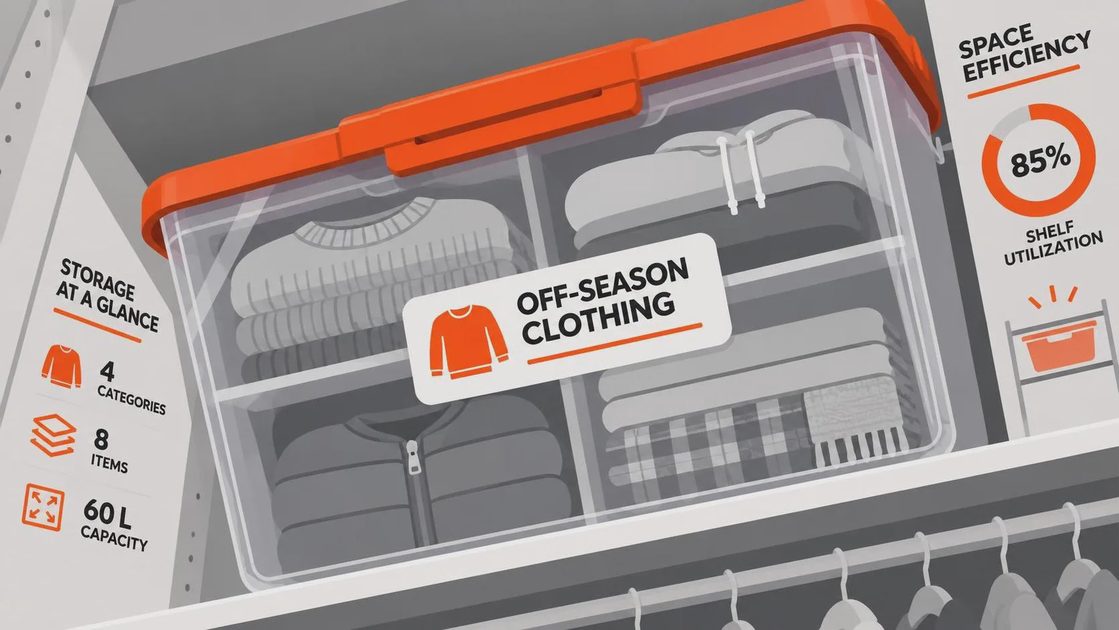
Seasonal rotation fails when it becomes an entire Saturday project. Store the incoming season in the easiest-to-reach section and place the outgoing season in clean, labeled containers. Wash or dry-clean clothing before storage, then let it dry completely. Cedar blocks can discourage some insects, but they do not replace cleaning or a sealed container.
Fold sweaters loosely to avoid hard creases, and never pack damp shoes or leather goods. Use shoe boxes only when you can identify the contents from the outside. Otherwise, a breathable shoe bag with a simple label prevents the common problem of opening every box to find one pair of boots.
When you organize closet top shelf storage for winter, do not put heavy coats into a bin that you cannot lift safely. Use a lower shelf, a high hanging rod, or a separate hall closet instead. A storage plan is not successful if it requires strained shoulders or a precarious climb.
What Belongs Somewhere Else
Top shelves are not a solution for every closet overflow problem. Daily handbags belong at eye level or on hooks. Jewelry needs a drawer or a protected organizer. Shoes that you wear weekly should not live in a deep bin above your head. The same goes for medication, important documents, and anything vulnerable to temperature or humidity changes.
Large suitcases can use the top shelf if the shelf is structurally rated for the load and you can pull the case down without twisting. Otherwise, use under-bed storage or a hall closet. Check door clearance as well. A shelf that extends too close to the jamb can make a suitcase impossible to remove without scraping paint or damaging the trim.
When I organize closet top shelf layouts during a renovation, I often specify a dedicated open bay for luggage rather than forcing suitcases into a row of small cubbies. That one decision saves space and makes the closet easier to use. It also keeps a future homeowner from drilling into a shelf system simply to create a larger opening.
A Practical Final Check
Stand outside the closet and look at the shelf as if you are arriving home in the dark. Can you identify each bin? Can you reach the front container without moving three others? Is the shelf level? Are the heaviest pieces low enough to lift safely? Can the door open fully with a step stool nearby?
If the answer is no, remove items before adding organizers. Measure again, reduce container size, or move the category to a better location. The most effective way to organize closet top shelf space is to reserve it for things that are light, seasonal, and clearly labeled. Build around your actual wardrobe, not an online photograph with no coats, luggage, or laundry in sight.





No comments yet — be the first to share a thought.